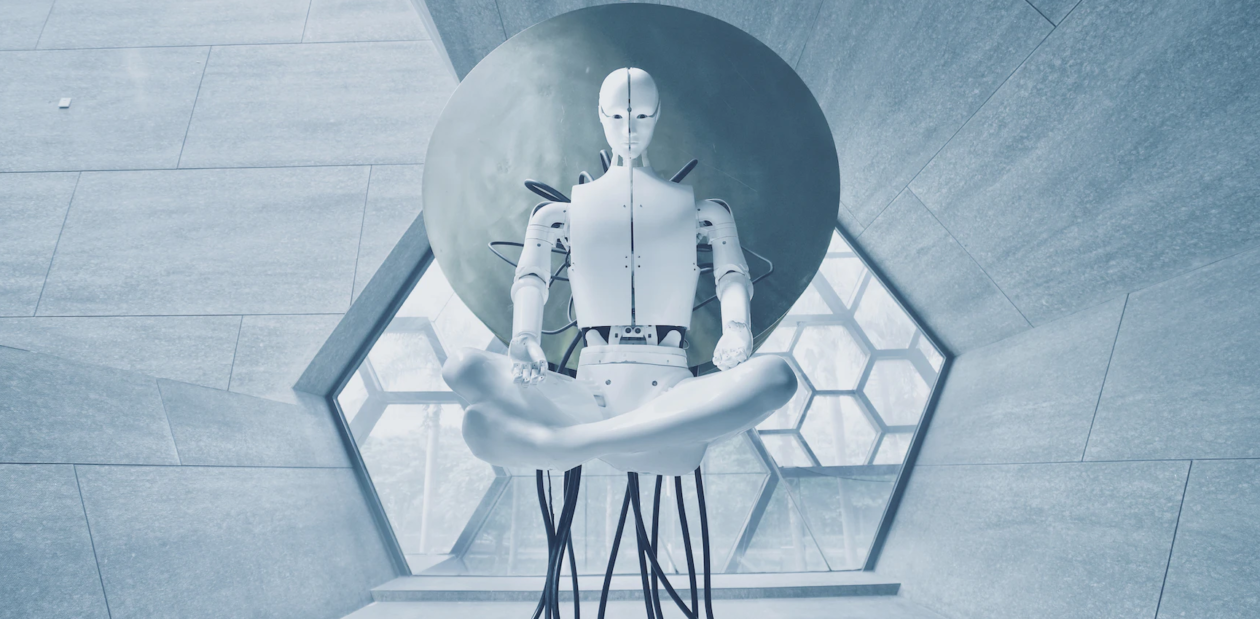

Welcome to a new semester! I really look forward to connecting with all of you soon. In many ways, this course has been “brewing” in my mind for a while. It attempts to ask some bold questions about the state of the world, the state of democracy, the state of education. In short, we will will ask many hard questions together. At the root of our shared inquiry will be the significance of writing. But we will try to connect that to questions about what make us human. I want to think more deeply with all of you about artificial intelligence – questioning its impact on thinking, on learning, and on caring for each other.
What does it mean to write in the age of AI and natural language processing? The algorithms can write faster than we can. A.I. has now mastered structure, form, and syntax, and perhaps style. Still, machine algorithms will never be sentient. While AI can mimic consciousness, it doesn’t truly “feel” or “think,” and the ability to have inner experiences remains a significant gap. Still, you can offer a prompt, and the program will spit out something useful within seconds. The prose will be grammatically correct. Words will be coherent. ChatGPT uses the entirety of the open web as its data set. So where does that leave us human writers?

For time immemorial, human beings have reached out to the world with words, hoping to connect and communicate, hoping to import both information and meaning to those on the receiving end of an intended message. We have tried to convey what we know, what we experience, what we think, what we feel. Writers hope to protect their authenticity and intention, and their unique human voice. But in a world where the machine can do some things more effectively and efficiently, how do we now reckon with the art and science of writing? What is the impact of artificial intelligence on the world as we know it? How is machine writing a game changing truth?
If we know that care and community are critical to how we learn, what is the future for learning and education, in a world written (in part) by machines trained on our own human output? In the Human Nature of Writing (HNOW) class, we will take a small journey together as we attempt to apprehend the stakes for writing in the age of AI.
I look forward to meeting for the first time this week, and getting our co-learning “collaboratory” up-and-running together.
See you soon,
Dr. Zamora
