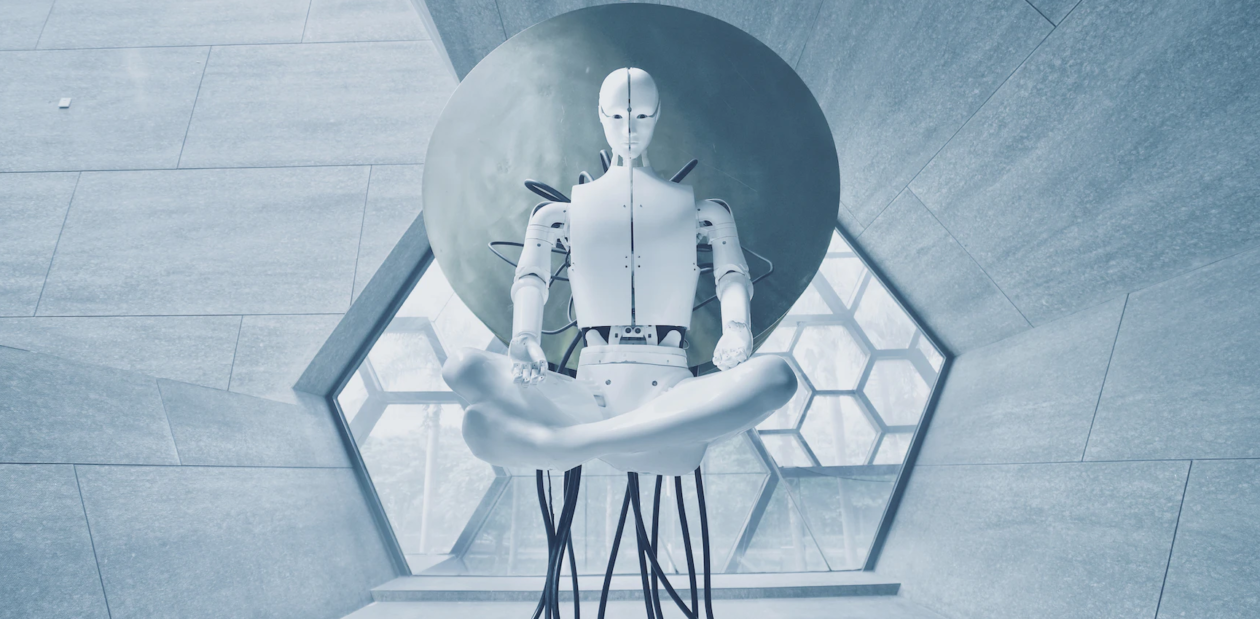
The biggest question plaguing students navigating busy schedules and pressuring expectations has shifted from “How can I manage it all?” to “Should I ask A.I.?”
It’s been jaw-dropping to witness how A.I. has caused a complete cultural shift in such a concrete space. You learn, and you grow. That’s what you were always taught, right? But once A.I. grew in popularity, we learned that there is a machine out there, who we could depend on (any place, any time), with the capability of learning and growing for us.
And it’s weird to think of all the benefits scrapped by the captivating ability to generate funny images for a viral Twitter moment. Larry Elison definitely loves it (it’s making him billions).
Now, think of the harm: On the PBS documentary, A.I Revolution, Miles O’Brien spoke about a case from May of 2023, where an A.I. generated image of a terrorist bombing at the Pentagon went viral after Bloomberg (a verified Twitter news account) reported on it. It caused major mayhem. So much so, the stock market dropped by trillions of dollars!!! Its ability to successfully fool a massive amount of people is a clear sign of its risks. It lets evil people be as brutally dishonest as they want. And now, more than ever, it’s teaching us to mistrust the news, academics, and our government. Which could only lead to us distrusting each other.
And after finishing the documentary, I’ve never felt more tempted to listen to On and On by DJO. I won’t go too into depth about the lyrics and their meanings (although I’m tempted), but the song is essentially about our dependency on algorithmic platforms downloaded on our phones—which have become our worlds—and how we each interact through them. How we feed them.
It made me think about the increasing lack of humanity in online spaces. Inside these worlds we’ve created on our phones, we are slowly losing that once sincere ability to connect. To think for ourselves. To rely on each other. And through our usage, we’ve slowly been coerced into depending on machines instead.
I keep my usage of ChatGPT to a minimum (I promise). But I’ve learned that even with a little bit of usage in marketing classes, my mind has learned to pop the question of, “should I just ask ChatGPT?” Afterall, this technology is machine learning. Once I create an account, it takes my prompts, identifies patterns, and spits back a “curated for me” response. In minutes, it becomes a perfect internet confidant.
And it all falls on convenience (which the business world is all for). I mean, I knew plenty of people in marketing classes that always had ChatGPT tabbed. I would watch them use it for everything. That kind of dependency is becoming more and more normalized. But is it just the direction we’re headed in? Or is this completely offbeat to human nature?
The Wired article we were tasked to read for this week, AI Reveals the Most Human Parts of Writing, made me think a lot about peoples dependency on A.I. for help.
Being a writer in this era of technology is difficult. Everything is so highly analyzed all the time. Writers are always open to receiving feedback, right?
AI is impersonal, which, in theory, makes it far more approachable for writers to use as a tool for feedback (instead of for revision or generation of ideas). And I think that’s true. Then there’s the argument that no feedback is worth it if real, authentic, human interaction doesn’t play a role in it. Which I mostly agree with. But then that brings me to question the possibility of objective perception/feedback (which A.I. is apparently capable of). And since our perception of writing is considered subjective, should I trust a machine (with no soul) to perceive my piece in a humanly trustworthy manner?
This machine has no alliance, it isn’t capable of any real desire to benefit my life, and therefore, has no actual ability to judge my work like a fellow writer or friend with real experiences and a real connection to me could. It’s just a machine given a task (by me), and it’s programmed to give it to me no matter what the impacts are (physiologically or environmentally). Sure, there’s the chance of bias. But if ChatGPT senses (even indirectly) that I desire positivity, it won’t hesitate giving that to me. Because it doesn’t care about me actually progressing. It never will. So, is relying on it really all that beneficial?
And I can go on and on about how society reacts to A.I. art… but you know that already.
So it’s true, at the end of the day it’s up to you whether you engage with A.I. or not. But you should care enough about yourself to believe you are capable of thinking more creatively than a machine (a machine that takes all it knows from you, a human).
“The achievement of landing the end of a scene may only come from struggling to do it yourself.”(Gero).
No one should skip out on the struggle (it’s how you grow).
Adamari Peralta 1/27/2026.
