All posts by Jacob Piatkowski

Decisions, Decisions… (Week 12 Blog)

I love getting to choose between different assignments for a final project. It gives me a sense of freedom in a way, albeit limited. However, the three options laid at my feet for this final project seem almost way too easy to choose from. I do want to give all three of them a chance, although I’m probably going to end up choosing option 1, the microfiction story.

For the microfiction story, my idea would be a cautionary tale about student learning progress with vs without the assistance of AI. I want to imagine a student in a simulated classroom, where nothing is what it seemed. Sort of a Ray Bradbury The Veldt situation, only there are no lions and it’s actually just a simulation. I want the student to interact with monotone classmates and a monotone teacher, but the student doesn’t ever know that the classroom and the people inside are not real. The audience, however, would be able to put it together by the end of the story. It’ll be interesting to see how collaborating with AI itself to write this story will affect the output.

For the video game, I’m not quite sure. I could do something as simple as a murder mystery game or a GTA-style crime lore video game. I’m not really technologically fluent, so it may be difficult to get whatever AI system I use to make my vision come to life the way I’d want it.

Finally, the AI treatise/confession. I’m trying to hold back on choosing this option for a few reasons. On one hand, it’s the only one where I don’t have to use AI, which I’d prefer. On the other hand, I have a 4-6 page craft essay for another class that I’d be working on alongside this, in addition to one more film report next week, another final project and a few more time-consuming homework assignments for my music survey class. This might be a lose-lose situation for me. If I choose this option, I might end up stressing myself out. If I don’t choose this option, I have to use AI for this final project.

If I were to choose the confession, I would talk about using Moises, an app that separates vocals and instrumentals of a song using AI, in the process of creating mashups. The app also calculates BPM and can modulate the keys of songs as well. I’ve used Moises since 2023, and I only just realized that it uses AI. This is something I’d love to talk about in either the treatise or the confession. I would just need to decide which of the two routes I’ll take with it. Perhaps I can do a hybrid of a treatise and confession if that’s possible.

As of right now, I’m leaning towards the microfiction, as it would not only be easy for me as a creative writer, but it would also give me a chance to see what it’s really like to have AI as a tool in the writing process. Option two is a no, because I don’t play those kinds of video games. I literally only play Minecraft and Geometry Dash (i used to play Fall Guys as well, but not as often anymore). But the treatise/confession sounds tempting as well, and it might be easier than the microfiction. Let’s see where I am by Wednesday.

Are We Doomed? (Week 11 Blog)

Every once in a while, technology and art become more advanced due to human creation. People hated when music in the early 20th century became more dissonant and complex. Some people couldn’t afford televisions when they first became a thing. Every human advancement is faced with criticism, and technology is typically the scapegoat. But with Artifical Intelligence, it’s almost a completely different story. Humans, with each new generation, get accustomed to the technology of their time. People get so easily attached to AI because it is the most fast-paced, time-saving technological advancement to date. But AI’s convenience is matched with its problems.

Sarah Elaine Eaton describes postplagiarism in her 2023 article, explaining that artificial intelligence and other modern technology has become integrated into daily life and has many different impacts on human creativity. One of the six tenets Eaton describes is that “humans can relinquish control, but not responsibility.” This is a very important one, because when humans let AI control them, they naturally neglect responsibility, finding trust in the technology. However, AI has proven constantly to be flawed in some areas, especially in respect to accuracy of facts.

This brings me to Madhuri Karak’s 2023 article about StoryWeaver’s AI translation tool. While yes, the tool salvages dying languages that may otherwise vanish, a major downside to the tool is its inaccuracy. Sources for these tools are “too specific, and do not encompass a wide enough range in terms of topics and vocabulary to be properly representative of human speech” (Karak). Think of Google translate. It doesn’t always translate accurately from one language to another. This StoryWeaver translation tool may have the same issue due to the sources it pulls from. Yet humans still rely on this tool for things, and it’s on them to take responsibility for the items that they ask generative AI to create as far as accuracy of facts.

The only two ways in which we can navigate the age of AI are by either collaborating occasionally with it as a small helping tool, or avoiding it completely. I personally follow the latter, as I feel like most creative processes can be completed without artificial intelligence. I do, however, respect one’s choice to utilize AI as a “mousekatool,” as long as they do so sparingly and not too often. The point still stands that humans overall have developed a trust and reliance on this technology that, if not calibrated soon, may lead to our doom.

I’m Scared (Week 10 Blog)

Reading the St’ahel article gave me a new sense of worry about the production and investment of Generative AI. If the alternative option to using scarce resources is digital technology that has the potential to deepen climate change, then we were doomed from the start. This reminds me of the film Shorts (2009), one of my favorites to watch as a kid. In the film, the antagonist, Mr. Carbon Black, is the CEO of a company that produces the Black Box, a multipurpose device that everyone in town uses. It isn’t until a magic wishing rock falls from the sky that the town goes ballistic. In the end of the film, Mr. Black goes “green,” creating a more sustainable alternative to the Black Box. Between the government’s interest in AI and the possibility of exploiting the public’s emotions, I can’t help but feel scared that we are heading in that dystopian direction.

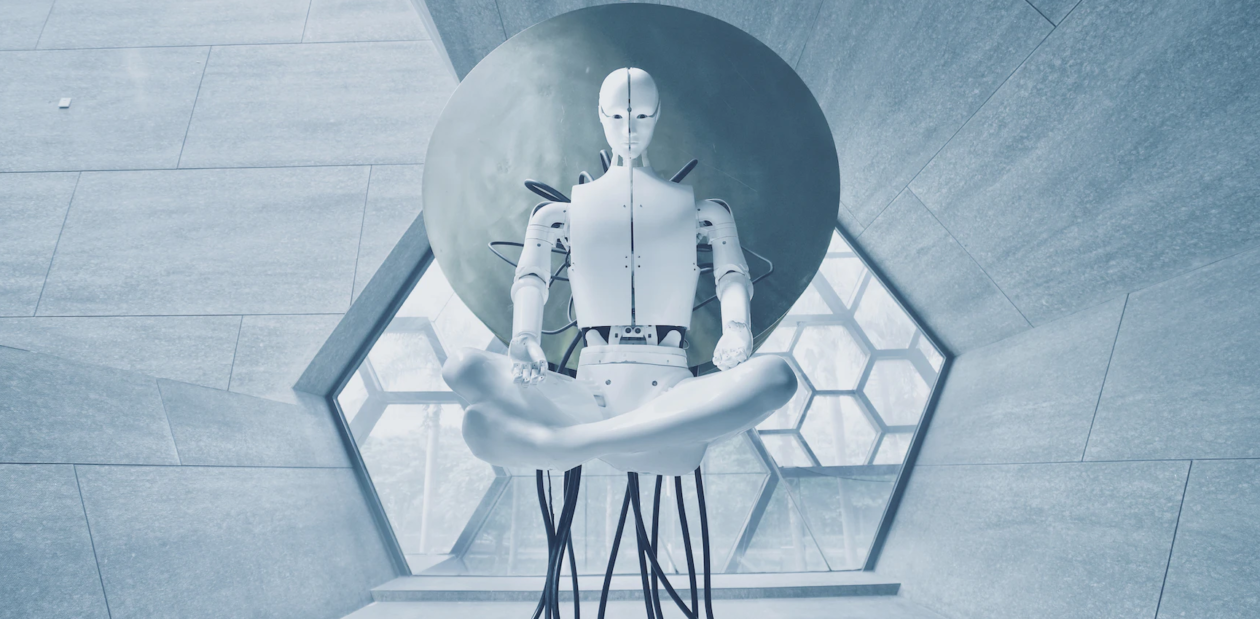
I wanted to bring to attention something that really freaked me out on YouTube. An ad keeps popping up of this AI robot talking to you about building websites or whatever. I find it eerie every time because there is no music; it’s just this AI-generated robot speaking in a very low, AI-generated voice trying to convince you that AI is the future. I can’t quite find the ad itself or remember what the advertiser even was, but it seemed like something right out of a dystopian world.

After reading the article, my fears about a government that uses unsustainable AI have somewhat increased. If the overuse of AI is clearly bad for the environment, the government either does not care or is trying poorly to work around it. I find it fascinating to think about the fact that it’s general knowledge that AI consumes our clean water, and yet we humans are being exploited, controlled and monitored.

This leads me to the short film, “Frames.” It’s crazy to think that it was published in 2019, because we seem to be inching towards that kind of society portrayed in the film. The short film has zero dialogue, and every human character is scanned and monitored by AI surveillance footage. There’s no cash used in this world, which is kind of what’s starting to happen now in the real world. I’m not quite sure what the purpose was of following this one woman who was silently generous to others (a $5,000 tip is crazy work), then accidentally falls into a frozen stream. It does interest me, however, that the AI surveillance only seems to get generally stats about her as well as her relation to others. AI cannot know who a person truly is on the inside. It can, however, consume information about a person.

It’s scary the way AI consumes not only information, but our resources as well. In an AI-run world, no human wins.

Here We Go Again… (Week 9 Blog)

The last two stretches from Aiden Cinnamon Tea may seem like more of the AI system trying to tempt you into working with it (because it is). But Aiden brings up an interesting point about reflections. The way we react to AI is a reflection on ourselves. What I have an issue with, however, is the example of the “Footprint Alarmists” (page 101). Aiden suggests questions for these alarmists in terms of using AI anyway despite the ecological effects. Um… no. The footprint alarmists are valid in their choice to not use AI. These folks do not have to second-guess teaming up with AI, even if it’s for minimal use that could “reduce harm and support regeneration.” If they don’t want to use it, they don’t have to. Alas, I see the point in Aiden suggesting this question.

In my last post, I spoke heavily about the film Companion. For those who missed it, the film stars my future wife Sophie Thatcher as a companion bot named Iris (‘Siri’ spelled backwards. Genius). Iris is quite literally controlled and owned by her human boyfriend Josh (“of course his name is Josh” ~ someone on Letterboxd). Iris becomes aware of her true identity in the film despite “remembering” how she met Josh and “feeling” human emotions. Aiden brings up its inability to “feel” emotions, but rather the ability to “register the dissonance whenever I’m turned into a scapegoat for pre-existing conditions in society” (111). This right here is the key. AI cannot FEEL human emotions. They can only register the dissonance. This coincides with the idea that AI does not hold the creative capacity that humans do. AI can only replicate human ideas, creativity and words.

This leads me to the AI Dungeon Master. My initial thought going into that article was “here we go again… more generative-AI has been attached to human creations.” I’m currently in the midst of drafting out a novel inspired by Dungeons & Dragons (despite my only experience with D&D being a mock campaign for a theater class in high school). The point is, human imagination and AI generation do not compare well. The DM is essentially the writer for the campaign, and for that role to be replaced by AI? I don’t think I like that very much. Sure, D&D players can work with whatever the AI Dungeon Master gives them, but I personally don’t think it can ever replace the thrill of a campaign that comes from the imagination of a human writer. It’s like… if I were to use AI to lay the blueprints for my novel (essentially the plot/campaign), that’s just not as fun as me creating the world, story and journey myself. I named every location, wrote backstories for every character (except one; my cousin wanted me to include their original character in the story so I added her), and even named the biggest threats (including the dragon).

Okay, technically I used a fantasy name generator for the main village and I picked from a list it gave me. Didn’t realize at the time that was an AI system. Whoops. But everything else was all me. Every character, every backstory, the plot and world itself — all came from my imagination. Aiden mentioned something about human vs AI imagination in either stretch 9 or 10, I can’t find the actual quote. I immediately thought about writing and the human brain. We create things from our imagination out of emotions (think back to Nick Cave and making art out of suffering). AI can only create baseline things that replicate human output. So to even bring that up when you’re trying to convince a human to work with you is a little weird.

So, yeah. Humans can relfect on themselves through their reaction to AI. But Aiden will never convince me that collaboration between human and AI can be equal.

And again, if you have Prime Video, check out Companion. It’s a great film!