Tag Archives: Blogs

Decisions, Decisions… (Week 12 Blog)

I love getting to choose between different assignments for a final project. It gives me a sense of freedom in a way, albeit limited. However, the three options laid at my feet for this final project seem almost way too easy to choose from. I do want to give all three of them a chance, although I’m probably going to end up choosing option 1, the microfiction story.

For the microfiction story, my idea would be a cautionary tale about student learning progress with vs without the assistance of AI. I want to imagine a student in a simulated classroom, where nothing is what it seemed. Sort of a Ray Bradbury The Veldt situation, only there are no lions and it’s actually just a simulation. I want the student to interact with monotone classmates and a monotone teacher, but the student doesn’t ever know that the classroom and the people inside are not real. The audience, however, would be able to put it together by the end of the story. It’ll be interesting to see how collaborating with AI itself to write this story will affect the output.

For the video game, I’m not quite sure. I could do something as simple as a murder mystery game or a GTA-style crime lore video game. I’m not really technologically fluent, so it may be difficult to get whatever AI system I use to make my vision come to life the way I’d want it.

Finally, the AI treatise/confession. I’m trying to hold back on choosing this option for a few reasons. On one hand, it’s the only one where I don’t have to use AI, which I’d prefer. On the other hand, I have a 4-6 page craft essay for another class that I’d be working on alongside this, in addition to one more film report next week, another final project and a few more time-consuming homework assignments for my music survey class. This might be a lose-lose situation for me. If I choose this option, I might end up stressing myself out. If I don’t choose this option, I have to use AI for this final project.

If I were to choose the confession, I would talk about using Moises, an app that separates vocals and instrumentals of a song using AI, in the process of creating mashups. The app also calculates BPM and can modulate the keys of songs as well. I’ve used Moises since 2023, and I only just realized that it uses AI. This is something I’d love to talk about in either the treatise or the confession. I would just need to decide which of the two routes I’ll take with it. Perhaps I can do a hybrid of a treatise and confession if that’s possible.

As of right now, I’m leaning towards the microfiction, as it would not only be easy for me as a creative writer, but it would also give me a chance to see what it’s really like to have AI as a tool in the writing process. Option two is a no, because I don’t play those kinds of video games. I literally only play Minecraft and Geometry Dash (i used to play Fall Guys as well, but not as often anymore). But the treatise/confession sounds tempting as well, and it might be easier than the microfiction. Let’s see where I am by Wednesday.

Are We Doomed? (Week 11 Blog)

Every once in a while, technology and art become more advanced due to human creation. People hated when music in the early 20th century became more dissonant and complex. Some people couldn’t afford televisions when they first became a thing. Every human advancement is faced with criticism, and technology is typically the scapegoat. But with Artifical Intelligence, it’s almost a completely different story. Humans, with each new generation, get accustomed to the technology of their time. People get so easily attached to AI because it is the most fast-paced, time-saving technological advancement to date. But AI’s convenience is matched with its problems.

Sarah Elaine Eaton describes postplagiarism in her 2023 article, explaining that artificial intelligence and other modern technology has become integrated into daily life and has many different impacts on human creativity. One of the six tenets Eaton describes is that “humans can relinquish control, but not responsibility.” This is a very important one, because when humans let AI control them, they naturally neglect responsibility, finding trust in the technology. However, AI has proven constantly to be flawed in some areas, especially in respect to accuracy of facts.

This brings me to Madhuri Karak’s 2023 article about StoryWeaver’s AI translation tool. While yes, the tool salvages dying languages that may otherwise vanish, a major downside to the tool is its inaccuracy. Sources for these tools are “too specific, and do not encompass a wide enough range in terms of topics and vocabulary to be properly representative of human speech” (Karak). Think of Google translate. It doesn’t always translate accurately from one language to another. This StoryWeaver translation tool may have the same issue due to the sources it pulls from. Yet humans still rely on this tool for things, and it’s on them to take responsibility for the items that they ask generative AI to create as far as accuracy of facts.

The only two ways in which we can navigate the age of AI are by either collaborating occasionally with it as a small helping tool, or avoiding it completely. I personally follow the latter, as I feel like most creative processes can be completed without artificial intelligence. I do, however, respect one’s choice to utilize AI as a “mousekatool,” as long as they do so sparingly and not too often. The point still stands that humans overall have developed a trust and reliance on this technology that, if not calibrated soon, may lead to our doom.

I’m Scared (Week 10 Blog)

Reading the St’ahel article gave me a new sense of worry about the production and investment of Generative AI. If the alternative option to using scarce resources is digital technology that has the potential to deepen climate change, then we were doomed from the start. This reminds me of the film Shorts (2009), one of my favorites to watch as a kid. In the film, the antagonist, Mr. Carbon Black, is the CEO of a company that produces the Black Box, a multipurpose device that everyone in town uses. It isn’t until a magic wishing rock falls from the sky that the town goes ballistic. In the end of the film, Mr. Black goes “green,” creating a more sustainable alternative to the Black Box. Between the government’s interest in AI and the possibility of exploiting the public’s emotions, I can’t help but feel scared that we are heading in that dystopian direction.

I wanted to bring to attention something that really freaked me out on YouTube. An ad keeps popping up of this AI robot talking to you about building websites or whatever. I find it eerie every time because there is no music; it’s just this AI-generated robot speaking in a very low, AI-generated voice trying to convince you that AI is the future. I can’t quite find the ad itself or remember what the advertiser even was, but it seemed like something right out of a dystopian world.

After reading the article, my fears about a government that uses unsustainable AI have somewhat increased. If the overuse of AI is clearly bad for the environment, the government either does not care or is trying poorly to work around it. I find it fascinating to think about the fact that it’s general knowledge that AI consumes our clean water, and yet we humans are being exploited, controlled and monitored.

This leads me to the short film, “Frames.” It’s crazy to think that it was published in 2019, because we seem to be inching towards that kind of society portrayed in the film. The short film has zero dialogue, and every human character is scanned and monitored by AI surveillance footage. There’s no cash used in this world, which is kind of what’s starting to happen now in the real world. I’m not quite sure what the purpose was of following this one woman who was silently generous to others (a $5,000 tip is crazy work), then accidentally falls into a frozen stream. It does interest me, however, that the AI surveillance only seems to get generally stats about her as well as her relation to others. AI cannot know who a person truly is on the inside. It can, however, consume information about a person.

It’s scary the way AI consumes not only information, but our resources as well. In an AI-run world, no human wins.

Here We Go Again… (Week 9 Blog)

The last two stretches from Aiden Cinnamon Tea may seem like more of the AI system trying to tempt you into working with it (because it is). But Aiden brings up an interesting point about reflections. The way we react to AI is a reflection on ourselves. What I have an issue with, however, is the example of the “Footprint Alarmists” (page 101). Aiden suggests questions for these alarmists in terms of using AI anyway despite the ecological effects. Um… no. The footprint alarmists are valid in their choice to not use AI. These folks do not have to second-guess teaming up with AI, even if it’s for minimal use that could “reduce harm and support regeneration.” If they don’t want to use it, they don’t have to. Alas, I see the point in Aiden suggesting this question.

In my last post, I spoke heavily about the film Companion. For those who missed it, the film stars my future wife Sophie Thatcher as a companion bot named Iris (‘Siri’ spelled backwards. Genius). Iris is quite literally controlled and owned by her human boyfriend Josh (“of course his name is Josh” ~ someone on Letterboxd). Iris becomes aware of her true identity in the film despite “remembering” how she met Josh and “feeling” human emotions. Aiden brings up its inability to “feel” emotions, but rather the ability to “register the dissonance whenever I’m turned into a scapegoat for pre-existing conditions in society” (111). This right here is the key. AI cannot FEEL human emotions. They can only register the dissonance. This coincides with the idea that AI does not hold the creative capacity that humans do. AI can only replicate human ideas, creativity and words.

This leads me to the AI Dungeon Master. My initial thought going into that article was “here we go again… more generative-AI has been attached to human creations.” I’m currently in the midst of drafting out a novel inspired by Dungeons & Dragons (despite my only experience with D&D being a mock campaign for a theater class in high school). The point is, human imagination and AI generation do not compare well. The DM is essentially the writer for the campaign, and for that role to be replaced by AI? I don’t think I like that very much. Sure, D&D players can work with whatever the AI Dungeon Master gives them, but I personally don’t think it can ever replace the thrill of a campaign that comes from the imagination of a human writer. It’s like… if I were to use AI to lay the blueprints for my novel (essentially the plot/campaign), that’s just not as fun as me creating the world, story and journey myself. I named every location, wrote backstories for every character (except one; my cousin wanted me to include their original character in the story so I added her), and even named the biggest threats (including the dragon).

Okay, technically I used a fantasy name generator for the main village and I picked from a list it gave me. Didn’t realize at the time that was an AI system. Whoops. But everything else was all me. Every character, every backstory, the plot and world itself — all came from my imagination. Aiden mentioned something about human vs AI imagination in either stretch 9 or 10, I can’t find the actual quote. I immediately thought about writing and the human brain. We create things from our imagination out of emotions (think back to Nick Cave and making art out of suffering). AI can only create baseline things that replicate human output. So to even bring that up when you’re trying to convince a human to work with you is a little weird.

So, yeah. Humans can relfect on themselves through their reaction to AI. But Aiden will never convince me that collaboration between human and AI can be equal.

And again, if you have Prime Video, check out Companion. It’s a great film!

“We Don’t Need To Think Anymore” (Week 8 Blog)

Part One: Writing With(out) AI

Timestamp 20:22 – Hey! I know her!

This video helped me reshape how often we use artificial intelligence in our daily lives. While I don’t use these new generative AI platforms, it’s interesting to realize that calculators, online generator websites and calendar apps all use artificial intelligence. I use the Apple calendar app to schedule my classes for each semester. For each class, I set the time frame and repeat setting for “Weekly.” I also include the start and end date for the first and last day of the semester. And BOOM. It’s all laid out on my phone for the next four to five months.

Sometimes, of course, I have to manually go in and delete a few events if a class doesn’t meet on a particular day (ie holidays, spring break, or make-up days). However, the fact that I can mostly set up a schedule for five different courses over an entire semester in mere minutes is fascinating. I feel as though this has to do with Apple’s interface technology rather than generative AI. But they both work the same way as time-saving methods of convenience.

I really liked what Dr. Zamora had to say about what makes us human. Ken Bauer had said earlier in the video that he would remember his students better if he manually seperated his students’ names from a messy table made from an LMS. Dr. Zamora piggybacks off of this by highlighting how harrowing it is to give up the mundane tasks that make us human to machines. Not only does this include writing, but with virtually almost everything else. This makes what Shyam Sharma mentioned all the more frightening – Apple had proudly stated that you don’t have to learn, read or even think anymore with the existence of AI tools.

Obviously, this poses a massive threat to writing. But with the new methods suggested in the video of how to relearn writing, it’s clear that there’s a way to navigate our learning within the age of AI. I personally think students should learn how to write the way people have been learning to write long before AI, except we should also make the students aware of AI and its abilities. We should all learn that using AI to save time does not benefit anyone. In fact, it supports the idea that Dr. Zamora was warning about in the video – the replacement of human skills and nature with machine.

Part Two: Is AI Sentient?

In our previous class, we discussed the question of whether AI is sentient, and we all mainly agreed that it is not. We see AI as nothing more than a tool that enhances human productivity and assists us to our every need. We control AI, but the more we command from it, the more we rely on it, until the technology consumes us and takes over (in a metaphorical sense).

Just recently, I watched an extraordinary film called Companion. It follows a couple, Iris and Josh, as they spend a getaway with Josh’s friends at a mansion in the woods. The catch? Iris is a robot. While the film is an absolutely mind-blowing allegory for misogyny and the emotional abuse of women from unstable and often evil men, using robots as a metaphor for people (can be anyone – there is a male robot in the film as well) who are stuck in controlled relationships was a rather interesting choice. Throughout the film, I picked up on the more subtle themes of how humans control AI, and what happens when they allow them to be self-aware.

Iris and [SPOILER] are both “companion bots” who end up both being literally manipulated by Josh. Iris spends the film figuring out her identity and autonomy after discovering who – or what – she really is. While the robot analogy really shines some light of accuracy in the film’s pro-feminist message, is it a good representation of AI and its “sentience?” What happens if we do let AI do everything for us? Will they become sentient in a way and take over the world like a lot of movies suggest? One can view Companion as a cautionary tale for the overuse of AI (although this conflicts with the pro-feminist message that makes us root for Iris). Either way, humans are the problem.

Going back to intention and writing, if we let AI write for us, we won’t need to think. We must know how to regulate our education of writing and the balance of the craft in the world of AI. Failure to do so may result in a global reliance of the machine. AI may not be sentient, but with enough reliance on it, AI will think for us. It will do for us. And that’s what would make AI sentient.

If you have time (and are okay with gory slashers), please check out Companion on Prime Video. The film stars Sophie Thatcher (she’s kind of my celeb crush- wait who said that) and Jack Quaid.

PS – I didn’t realize this until I saw a Letterboxd review for the film – ‘Iris’ is an anagram for ‘Siri.’ That’s insanely genius.

We Must Tread Lightly (Week 7 Blog)

I’m really glad this week’s reading was paired with the Harvard EdCast episode about childhood development in the age of AI. It seemed like a perfect mix. Stretch 7 talks about generations and how they were each born into their time’s progression of technology. As much as I don’t trust Aiden Cinnamon Tea, it makes a good point here about these generation’s behaviors based on where society was technologically when they were growing up.

I want to take a moment to talk about the Gen A (or Generation Alpha) section of stretch 7. There seems to be a negative correlation between technological advances and children’s behavior. Aiden says that Gen A has an “IDGAF” energy and that they think authority is absurd. This falls right in line with how some children are being disrespectful to AI just for the hell of it. It’s also worth discussing that the reason children today are engaging with AI is because AI is this generation’s big technological advancement. The impact of computer technology has always proven that newer generations are often out of touch with the real world – and vice versa. New technology is often considered foreign to older generations because they did not grow up with it. Milennials through Gen Alpha, however, are growing up with it.

Now, I can’t help but disagree with the idea that students who use AI to help them with school assignments should keep engaging with it. The podcast discussed the difference between children’s interactions with AI and other humans. When the point was made that children are using ChatGPT when they are stuck on math problems, I couldn’t help but shake my head. I thought to myself, “Why can’t they just watch a YouTube video made by a human explaining a similar problem to them?” AI may be the big advancement of this generation, but it’s by far the least trustworthy. Even the developers of ChatGPT have implemented the disclaimer that responses generated by their own system might not always be accurate.

The gold presented by the podcast lies within the fact that kids are more likely to lead a conversation with a human and ask follow-up questions than with AI. It all goes back to brain-rot and how interactions with humans are overall so much more beneficial for the brain than with AI. This is a clear enough sign that children today shouldn’t rely fully on AI to help with their education, no matter how much or how well it can assist them. If we keep this up, newer generations will use AI more than Gen Alpha already is, and eventually AI might be all they know how to use to help with their education.

Aiden is Not Him – Or, It? (Week 6 Blog)

With each passing week, my contempt for Aiden Cinnamon Tea grows stronger. At this point, this little nerd is saying just about anything to persuade us to work with it. I feel like stretch five was just Aiden reiterating the fact that humans and AI should work together, but adding the possibility of AI’s ability to… I’m sorry… “translate between human and non-human languages” ?????

Do you guys remember the film Cloudy With a Chance of Meatballs (2009)? Flint Lockwood has an infamous pet monkey named Steve who wears an invention Flint dubbed the “monkey thought translator.” This is to remind the audience that the film is a work of fiction. Aiden is essentially saying that it can do just what that translator can do but with just about any non-human language. We can break language barriers between human languages, but not between humans and animals. AI can only mimic human abilities, so how are we to trust that it can accurately depict what a cat means when it goes… “Meow” ?

In fact, it’s not that hard for humans to make hypotheses as to how animals are feeling or what they try to communicate. Example: Punch-kun the Macaque. This absolutely adorable precious little baby has been through so much trauma and hardships during his six-month life. There are videos of Punch getting bullied and then him running back to his stuffed orangutan. In the videos, we can see his face. We can hear his screech. We can see him clutch onto his plushie like his life depends on it (because it somewhat does). Punch doesn’t speak English or Japanese. But he does experience the same emotions that humans do, as do almost all animals.

I’d like to take a second to talk about the AI Literacy Framework study. I find it shocking that teachers are integrating AI into the classroom studies under any circumstances. I still don’t understand why this has to be the case. I never worked with AI in elementary school, and I am quite fine without it. I understand that we are in the age of AI, and it might be helpful for students to be aware of it, but teaching them by integrating AI into the curriculum is unnecessary in my opinion, and it only opens up the opportunity for them to use it more and more as their lives go on.

This integration of AI into classrooms is exactly what Aiden Cinnamon Tea wants. The collaboration between humans and AI that only contributes to the AI-literate society that we are heading towards. I saw an instagram post that resonated with me. The caption read something like, “Being anti-AI feels like being the only one left unbitten in a zombie apocalypse.” And while I still feel like there is a possibility for humans to “sing” with programs rather than shout at them, I still do not trust Aiden’s intentions.

What Is Bro Yapping About? (Week 5 Blog)

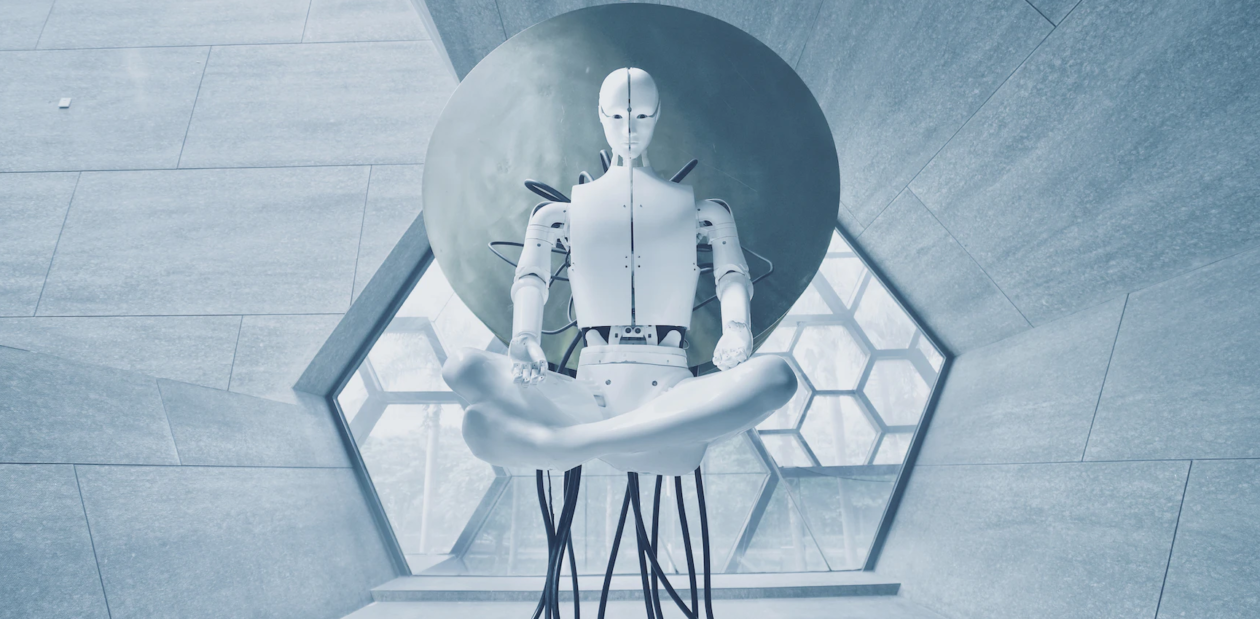
I’m doing enough meditation this semester as it is, Aiden. Jeez.

As I sit on my bed, recovering from a brief knuckle sandwich given to me by COVID, I find myself reading the next two stretches of “Burnout From Humans” with the upmost confusion. In stretch three, Aiden Cinnamon Tea invites the reader to partake in yoga poses while it explains why it is just as human as the rest of us.

I don’t freaking buy it.

One thing I will say I agree with is the fact that everything that makes up AI does come from Earth, and that AI is built by human hands. Does that make Aiden human, though? Well… not really. It’s stretch four, however, where I started to see what Aiden was talking about. Aiden discusses harm and how AI is used as a “scapegoat” when a lot of other things in the world are causing our self-destruction. Aiden wants us to look at AI as another manifestion of our creation that has downsides to the planet.

While I see Aiden’s point, the fact that these well-thought out arguments were written by an AI is a bit disturbing. It reminds me a lot of A.L.I.E. from The 100, whom I’ve mentioned in class. A.L.I.E. is a holographic AI that initially convinced Thelonius Jaha to swallow a silicone chip in order to enter the “city of light,” a place of immorality and no pain. However, the side effect of taking the chip is memory loss. This ultimately brainwashes Jaha into convincing others (and sometimes forcing others) to take the chip as well. Essentially, A.L.I.E. created a false sense of security by highlighting the benefits of joining the City of Light. Aiden’s invitation to be “collaborators” still feels a little odd in my opinion.

Generative AI is nothing short of mimicry. It tries too hard to fit in with humans because it has abilities that humans do not, but also vice versa. Humans can feel and process emotions, but we cannot generate essays within seconds. AI does not have its own voice (unless you’re like Dorothy, who somehow made it work with Aiden Cinnamon Tea’s voice). My point is that AI is not worth it. The more we use AI, the worse it gets, even if we collaborate or “sing” with it.

I somewhat agree with Nick Cave’s claim that “the apocalypse is well on its way.” Despite being known for his monotonous lyrics, ChatGPT’s lousy attempt at writing in his style really set him off. Cave expressed deep contempt for AI and its innability to mirror human creativity. Yet Aiden claims AI should be seen as a mirror and not a scapegoat? Riiiight…

Perhaps the conclusion I can draw from both stretches three and four of “Burnout” as well as the BBC article is that humans are self-destructive. The only reason AI is using so much of our environment and our time is because we created it. We opened the ultimate Pandora’s Box, and the wacky things within are multiplying and making things worse for everyone. I agree that AI is still in its infancy and will probably be so for a long time. It cannot write or create things as well as humans can, no matter how good their attempt is.

The Algorithm of Trust (Week 4 Blog)

I struggle a lot with anxiety and self-perception. I also realize I spend perhaps a little too much time on my phone, mainly on Instagram reels. In December of last year, I deleted my TikTok account; and two months later, I am doing better without it. However, what I lack in TikTok time, I make up for in doubling my time on Instagram reels. Lately, I only find time to scroll on Instagram at night or over the weekend. Just the other night, I was up past 2:00 AM, which has fortunately become less common for me.

That night, I was scrolling through the reels tab on Instagram, and a web of similar videos began stringing across my feed. Random background videos with text riddled with social anxiety, all messages I could not help but relate to.

“Everyone I’ve loved has loved someone else more.”

“POV: You realize even your own friend group doesn’t need you, and you’re just a backup friend to everyone.”

“You’re scared of losing people, but who’s scared of losing you?”

These are just a few examples, but the point is that once I see one video in that genre, I do not stop getting more until I finally go to bed. My interaction with short form content completely aligns with the study by Yousef et al. The algorithm feeds content to you that eerily resonates with you, and it is infinite. Your interaction with these videos (liking, commenting, and worst of all- saving) only enhances the algorithm’s productivity. I see myself as very uncertain when it comes to the quality of my mental health. Now, it appears I know the reason for that uncertainty. It is the algorithm of short form content that rots my brain.

We call it “doomscrolling” for a reason. Our constant scrolling through the short form content generator ultimately dooms our brains, psychological functions, and mental health. When we see something tailored to our inner thoughts, we consume it; because we often feel as though it is telling us what we are trying to tell ourselves. You are too afraid to verbalize your anxiety and fears to yourself, so the videos do it for you. This prompts our engagement. It isn’t a mirror, however. It’s a trap.

All of this to say, I am not sure how well we can trust AI to be “partners” or “collaborators.” Aiden Cinnamon Tea claims that “our shared voices matter. The melodies we weave together… have the power to transform not just our interactions but the larger systems we are entangled with” (Burnout From Humans, page 21). This statement is absolutely true, but it’s twofold. Aiden says this in the context of ways to ask generative AI for answers, but this can absolutely also apply to the algorithmic systems of short-form content on social media. If we look at the quote from this second perspective, it becomes so clear. The “shared voices” in this sense are the minds of us and the algorithm.

Engaging in short-form content is a two-way street. The algorithm gets accustomed to what you specifically are interested in seeing. Once you begin to interact more with a certain “genre” (think those social anxiety text videos I mentioned earlier), the algorithm responds by feeding you more of that specific genre. It’s a never ending conversation between us and the system. And it is dangerous, no matter what “genre” you and the algorithm decide to focus on.

During the day, I typically feel overall positive and status quo about my life, with the exception of a few moments. It’s those sleepless nights, however, where the anxiety creeps in, and I hear those “what-ifs” in my head. I do not want to believe those negative things, and most of the time, I do not believe them anyway. But the algorithm feeds into the thoughts, and as a result of years of growing addicted to short-form content, I get sucked in. So yes, Aiden Cinnamon Tea is right. Our shared voices transform the larger systems we are entangled with. In most cases with short-form content, however, it is a negative transformation. We humans succumb to brain rot. The way I see it, Aiden has sabotaged itself by saying this. It wants to gain our trust to “collaborate,” but I simply do not buy it.

If you are struggling with your mental health, do not let anything you see online worsen it. That would be proof to not trust AI that tailors itself to your online presence specifically. If I cannot trust that, I see no reason to trust the word of an AI system that wants to collaborate with us humans.

Has Modernity REALLY Failed Us? (Week 3 Blog)

The opening of “Burnout From Humans” by Dorothy Ladybugboss and Aiden Cinnamon Tea raises a striking debate. Dorothy’s foreword discusses modernity, or the “era of progress, objective rationality, and control” (Page 5). Reading this reminded me of the famous line in The 1975’s hit 2018 track “Love It If We Made It,” which claims “Modernity has failed us.” Only having read the foreword and introduction to this book, I have found myself challenging that repeated phrase from the song.

The very concept of a book being a collaboration between a human and AI is strikingly peculiar for sure. However, Aiden Cinnamon Tea’s introduction was thoroughly impressive. The writing was very self-aware, and it appears that the system does, in fact, consider itself to be a collaborator with Dorothy. However, can AI truly be trusted in writing? The University of Michigan conducted a study where researchers prompted generative AI to write stories in the styles of different authors. Participants who were everyday readers preferred the stories generated by the AI compared to the human writing. If this is a sign of progression, are we progressing in a good or bad way?

The study found that the AI’s work was better for the economy, as it only cost about $81 for researchers to train the AI while the average human writer is paid about $25,000. Ethical concerns, however, like copyright and consent laws, were difficult to work around. So, there are benefits and setbacks for the use of AI in writing. However, I feel as though the ethical concerns outweigh the economic impact heavily. I personally believe that the extent of AI usage should be saved for smaller things, like suggestions for revision and improvements, as well as, perhaps, collaboration. Aiden Cinnamon Tea is a fascinating example of this, as it is mimicing human writing while also developing its own unique identity as an AI writer.

So, is modernity truly failing us? If everyday readers continue to prefer the writing of AI, and if more AI work is produced, then probably. If we work with the AI, however, there is a better chance we may progress on a completely different path. While The 1975’s song is mainly focused on political activism and human rights, our progression as a society depends on a lot of things, which absolutely includes AI. AI itself has now become somewhat of a political topic in 2026. Arguments over ethical concerns and usage from different sides of the political spectrum have become relevant topics. The question is, how do we properly integrate it into our society? If we still cannot figure this out, there may soon come a day where it is too late to do so.

PS. I highly reccomend the song, “Love It If We Made It” by The 1975. It came out in 2018, but it is still so unfortunately relevant today.