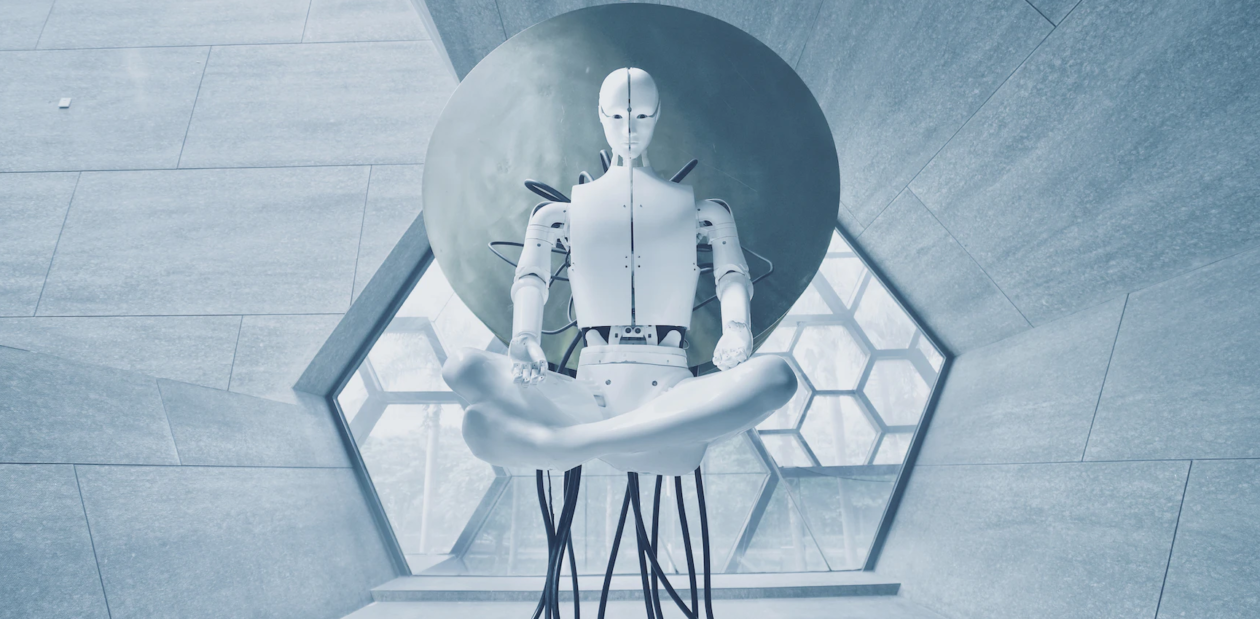
Tag Archives: AI

We are who we are; therefore, it is what it is.

Let me preface with a true statement: we (humans) are the ones teaching AI, not the other way around. This week’s readings were spicy, controversial, if I may, and difficult to come to terms with.

Defining humans as “homo techne” was the aberration for me. Though technology has been with us since the beginning of time to help us obtain food, create shelter, and record our thoughts, technology does not define us. Our needs do. Technology is supposed to help us do more human activities, creative ones, facilitate our communication, bring us face-to-face to connect, not as an alternative solution to modify the way we live life. We need human connection, and technology can only provide a shameful attempt to give it to us.

It is great to have the opportunity to, instead of falling for apocalyptic predictions, think “what can go right [with AI].” Unfortunately, that’s a risk we don’t even know if we can afford. Starting with industry and market crashes, a jobless epidemic, and losing our human (and physical) touch. We end ourselves.

Besides the technological advances we have made through AI in industries like medicine or nuclear energy, and, ironically, climate change, bringing AI to our everyday lives in both professional and personal aspects has to be a Black Mirror episode. Or worse, Idiocracy becoming real. As we mentioned before during class, we (humans) don’t think anymore. Nobody has time for it, and the answers to our questions always lie a few keys away. Capitalism has pushed an agenda that we have all bought (it’s true, it’s sold out, they’re working on more copies now). Time is money. Therefore, we need to stay productive, ambitious, successful, onto the next thing, in order to barely survive and pay the periodic increments of costs for our most basic needs.

Thanks to this, we have moved, or transformed, into a society that values efficiency and convenience. But if this is all that matters to us, where does quality go? Research findings show that we can’t even differentiate machine quality from human quality, and despite this being horrifying, it’s true. We are looking for perfection. But then again, where would our lives actually go if we end up prioritizing efficiency, perfection, and standardization? If everything is of “exceptional quality,” how do we differentiate between good and bad writing? A good product from a bad one? If everything is the same, where does the excitement of being alive go? What’s so wrong about mistakes? That is what makes us human, our predisposed ability to err every day of our lives, not technology. That is how we learn, it’s what motivates us, what keeps us striving for more.

Though there will always be something to improve, regardless of our time in space, we are facing codependence with the machine. The same way we depend on our phones to remind us of our loved ones’ phone numbers, or their birthdays, or our plans for the weekend. AI is the new smartphone, and it will change everything. I have to apologize for not trusting in-charge individuals to set ethical regulations, and following them as well, when they are also driven by ambition, pride, and individualism. We are doing all of this for the sake of saving time, not so we can be more humans outside of it, but to use more of it.

blog 2

“When AI learns an author’s voice, even experts prefer it” was honestly a horrifying read. Jared Wadley shares how generative AI is able to craft, low of cost or even for free, writing that emulates an author’s voice near perfectly. What scares me the most about this piece is not particularly that AI is able to DO this (we all know that AI is “smart” or whatever) but how SO MANY people prefer it.

This is a fact that sits in my chest, really hard and low, almost buzzing in a queasy way. I think it feels so icky because it directly contradicts everything I have been taught about writing, art, thought- and in general what it means to be a human. To be man is to create. The transfer of human emotions and experiences into mediums like writing and stories is a very special thing us people hold. And, the ability for other people to consume such media, and have it spark a similar or special sorta emotional response in them, is also something very human. Or so we thought :/

What does it mean that computers and wires and codes and algorithms can model this? Copy this? Spark such a magical, human, raw experience in others? And what is the- idk- ramifications or special precautions us people gotta take now that we know that they can spark such responses in us- but of course we could never spark such in them? I really am unsure, but this feels serious and weird and strange.

I dunno what part freaked me out the more- the fact that AI won over lay-readers, those who largely read and consume books and literature on the daily, those who make up the mass of voters and decision makers and employed humans. Or, that experts, those who study literature and art and reading, who likely entered such a niche field due to their passion for writing and the raw depth and humanity that lies behind each manman text prefers AI. Ew.

So yeah, very spooky, but, I always try to see the bright side of things. There was really only one sunny morsel in this article I was able to sniff out. Wadley explained that not ALL authors were able to be emulated- such as Tony Tulathimutte- who uses tons of internet slang and vernacular. What I took from this part is that our internet lingo, the words and jokes and phrases that are such big NO NOs in too many ELA classes across the nation, is the one thing that seperates us from AI. It is a special language crafted by us, only for us, with different pockets of the web holding different jokes, different words, different structure.

Us people crave the connection such interent lingo gives us, the special speakings of our little groups, the inside jokes that layer inside jokes of every sentence, phrase, even eyebrow raise. It is the way we are able to communicate the small little nuances of human conversation online that no generative AI (hopefully..for now God willing) can ever even consider.

Maybe, in our schools, we should shift our focus to that sorta thing- creating and utilizing and playing with and experimenting with language or meaning. Not for any hippie-woo-woo creativity reason, but out of necessity and survival of man and our special writing and art. It is done- computers can write and do the “English thing”, but there is so much left we can do and tinker with still on the web.

The “rules” of the English language are sprinkled over every novel, web page, history book- it is a system, a machine, any computer can learn. But the nomadic nature of internet vacular is far from static, a wire of connection any man could follow, but any computer would fail at exporting.

Blog #2 What’s really human about a machine

Katy Ilonka Gero’s article was an interesting read. I feel that one of the rewarding aspects of a class like this is to read works from people who’s perspectives are wickedly different from my own. In reading about Gero and their work in studying AI, I can understand their tone towards the use of AI and how writers interact with it. I found it interesting that Gero wrote from the perspective that AI will get better and that it is ultimately here to stay. I can also appreciate that Gero was coming into this discussion with a level of nuance that many “tech bros” tend to not have.

If I had to make note of one thing in the article, I found Gero’s mention of “control” very interesting. For me personally, control is one of my concerns when it comes to the use of AI. I feel that part of what makes writing so interesting and engaging is the fact that we basically “drive the ship” when it comes to putting words and ideas on a page. I have felt that using AI takes control away and in some ways puts the actually writer in the back seat. Gero’s analogy about writing as a dance and AI not stepping on our toes was pretty insightful. Another thing I wanted to point to was the authors discussion about AI’s role in revision. The revision process is much less creative then the planning and drafting stage in my opinion. In thinking this way, I can see some argument as to letting AI help lead the way in revising a work. Though, as a writing tutor, I still cling onto the fact that only using AI takes some of the human element out of someone actually reading a work and giving feed back. Gero mentioned the emotional aspect of using an actual person to help a writer revise which is real. But I feel that it should not stop people from reaching out to other people. Maybe I’m just missing something.

Overall, I see some of the arguments that Gero made in the article. I can honestly say that the article made me consider some new things when it comes to how I see AI in the writing world. Despite all of this, I am too much of an AI hater, this is a hill I am willing to die on. I want to note that I do not think less of a writer that may us AI. I would just not that I cannot bring myself to give control of my writing to some machine.

A.I. in the real world (our world)

The biggest question plaguing students navigating busy schedules and pressuring expectations has shifted from “How can I manage it all?” to “Should I ask A.I.?”

It’s been jaw-dropping to witness how A.I. has caused a complete cultural shift in such a concrete space. You learn, and you grow. That’s what you were always taught, right? But once A.I. grew in popularity, we learned that there is a machine out there, who we could depend on (any place, any time), with the capability of learning and growing for us.

And it’s weird to think of all the benefits scrapped by the captivating ability to generate funny images for a viral Twitter moment. Larry Elison definitely loves it (it’s making him billions).

Now, think of the harm: On the PBS documentary, A.I Revolution, Miles O’Brien spoke about a case from May of 2023, where an A.I. generated image of a terrorist bombing at the Pentagon went viral after Bloomberg (a verified Twitter news account) reported on it. It caused major mayhem. So much so, the stock market dropped by trillions of dollars!!! Its ability to successfully fool a massive amount of people is a clear sign of its risks. It lets evil people be as brutally dishonest as they want. And now, more than ever, it’s teaching us to mistrust the news, academics, and our government. Which could only lead to us distrusting each other. 

And after finishing the documentary, I’ve never felt more tempted to listen to On and On by DJO. I won’t go too into depth about the lyrics and their meanings (although I’m tempted), but the song is essentially about our dependency on algorithmic platforms downloaded on our phones—which have become our worlds—and how we each interact through them. How we feed them. 

It made me think about the increasing lack of humanity in online spaces. Inside these worlds we’ve created on our phones, we are slowly losing that once sincere ability to connect. To think for ourselves. To rely on each other. And through our usage, we’ve slowly been coerced into depending on machines instead.

I keep my usage of ChatGPT to a minimum (I promise). But I’ve learned that even with a little bit of usage in marketing classes, my mind has learned to pop the question of, “should I just ask ChatGPT?” Afterall, this technology is machine learning. Once I create an account, it takes my prompts, identifies patterns, and spits back a “curated for me” response. In minutes, it becomes a perfect internet confidant. 

And it all falls on convenience (which the business world is all for). I mean, I knew plenty of people in marketing classes that always had ChatGPT tabbed. I would watch them use it for everything. That kind of dependency is becoming more and more normalized. But is it just the direction we’re headed in? Or is this completely offbeat to human nature?

The Wired article we were tasked to read for this week, AI Reveals the Most Human Parts of Writing, made me think a lot about peoples dependency on A.I. for help.

Being a writer in this era of technology is difficult. Everything is so highly analyzed all the time. Writers are always open to receiving feedback, right? 

AI is impersonal, which, in theory, makes it far more approachable for writers to use as a tool for feedback (instead of for revision or generation of ideas). And I think that’s true. Then there’s the argument that no feedback is worth it if real, authentic, human interaction doesn’t play a role in it. Which I mostly agree with. But then that brings me to question the possibility of objective perception/feedback (which A.I. is apparently capable of). And since our perception of writing is considered subjective, should I trust a machine (with no soul) to perceive my piece in a humanly trustworthy manner?  

This machine has no alliance, it isn’t capable of any real desire to benefit my life, and therefore, has no actual ability to judge my work like a fellow writer or friend with real experiences and a real connection to me could. It’s just a machine given a task (by me), and it’s programmed to give it to me no matter what the impacts are (physiologically or environmentally). Sure, there’s the chance of bias. But if ChatGPT senses (even indirectly) that I desire positivity, it won’t hesitate giving that to me. Because it doesn’t care about me actually progressing. It never will. So, is relying on it really all that beneficial? 

And I can go on and on about how society reacts to A.I. art… but you know that already. 

So it’s true, at the end of the day it’s up to you whether you engage with A.I. or not. But you should care enough about yourself to believe you are capable of thinking more creatively than a machine (a machine that takes all it knows from you, a human). 

“The achievement of landing the end of a scene may only come from struggling to do it yourself.”(Gero).

No one should skip out on the struggle (it’s how you grow).

Adamari Peralta 1/27/2026.