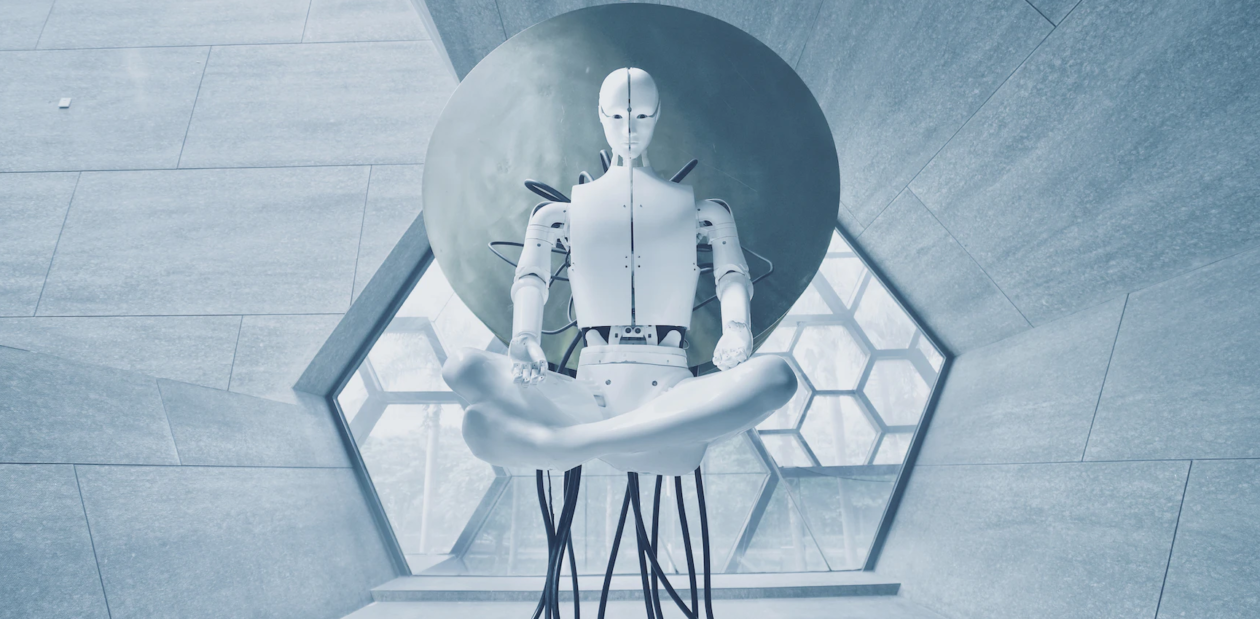
I think one of the (many ) things that irritates me about reading what Aidan Cinnamon tea has to say is its constant use of “we” and “us”. What do you mean “…we’re all trapped in the algorithmic hamster wheel”? What do you mean “we’re all complicit in letting the dinner table become a Wi-Fi hotspot?” It constantly groups itself with humans as if it’s already gained our acceptance throughout the chapters, which is far from the case. I think this also ignites a (maybe unreasonable) feeling of defensiveness within me. Am I well aware that this isn’t too far off from what dinners in public settings look like nowadays? Absolutely. I’ve worked in the restaurant industry for 8 years and unfortunately, that has absolutely become the reality. I’ve had tables as small as just 2 people or as big as 10 come in to celebrate birthdays or even just to have dinner and every single one of them have their phones out until the food comes out. The phones go away when the food arrives because there’s something to fill the silence. They ask how everyone’s food is, they talk about whether they’ve had a certain dish before and eventually, that small talk breaks the ice resulting in normal conversations. When everyone’s done eating and they’re waiting on the checks, everyone pulls their phones back out retreating into their personal bubbles. So am I painfully aware of how fair of a statement this is? Yes. I personally despise that and as a result of growing up with a “no phones at the table rule”, I don’t engage in it. Can I acknowledge the effects that each generation’s technology use has had on society and the environment? Absolutely. However, once again: right message, wrong messenger. That feeling of defensiveness comes from the idea that this AI program believes it has ties to us, embedded deeper within society than simply providing information. It implies that our struggles are its struggles, and that gives me the ick.
Tag Archives: student blog
AI in Education and Cinnamon hate
“especially in educational and social contexts” I never thought about the social contexts for children. I have heard the stories about people falling in love with the AI and stuff like that, but never considered children in the social contexts. I am just now thinking it might become a slang they use. Like instead of “Google it”, AI might become the thing they do. It might be the hip thing kids are doing, which is scary. I remember in fourth grade when people were starting to get phones and I didn’t have one. My classmates would call their younger siblings or each other just for fun. Then in high school I was given a Chromebook from the school to use. We all knew how to get around the locks on sites, it became the thing to talk about. I wonder if how we interacted with tech, having some people with it while others don’t have it like the phones or learning how to get it to do what we want with the Chromebook, is what kids are doing or talking about with AI.
“However, she emphasizes that while AI can simulate some educational interactions, it cannot fully replicate the deeper engagement and relationship-building that come from human interaction, particularly when it comes to follow-up questions or personalized conversations that are important for language and social development”. I think it is wild to give kids such access to AI. It should not be introduced so young; kids need foundation skills. Besides the worry about AI impacting learning by being wrong or not letting the kids work through problems, I am worried about them getting attached to the AI. If it does talk to them, they might not fully understand how real or fake AI is. Kids get attached to all kinds of things super quickly. I do not think it is good to give them something that some adults are having a hard time not connecting deeply to. I have seen a Tik Tok where the creator asks the Chat GPT to give an image of their relationship and the comment section was flooded with different pictures of a human and robot relationship. Kids don’t need something like this when they are learning about life.
“So the big question becomes whether children can benefit from those AI interactions in a way that is similar to how they benefit from interacting with other people.” No. And hopefully that is a no forever. Cause then AI really would be doing everything. It can even be the social interaction you need, which is crazy. No thank you. People are already struggling not to rely on it as it is. It already doing too much no need to have it be good to interact with. Though, Cinnamon would love it if people interacted with it nice.
“And the AI listens to the child’s response and offers small hints, just as a caregiver or a teacher would if the child needs help.” And so why can’t the caregiver do this. I have seen kids be so very attached to tech it is scary. As a kid, I would rather play with my toys than anything else. I found so many of the computer games boring. As I got older and became of age to play the PlayStation, that did change a bit, but I always made time for my toys. If parents could save time in their busy lives by having AI read to the kid, I know they would. I see my aunts and uncles put on some stupid YouTube for my cousins during holidays sometimes. I know it would happen. I do not blame them fully, for I get being busy. But reading to the child is a bonding moment. It shouldn’t just be seen as a chore but as a way to connect. It is a such a cute moment to see in film and TV too, and that might not be understood if these kids aren’t read to. If the benefit of AI to kids is what caregivers and teachers can do, do we really need the AI? Is the AI really beneficial if it does what can already be done? Sounds more like replacing to me than actually offering something good.
“Or request practical information, like recipes or the weather today. I actually view this as an area where AI can have a positive impact on children, because it significantly broadened children’s access to knowledge and information. However, a critical factor is that children must be able to engage critically with the information, and be aware of the potential for mis or disinformation.” I got a couple of notes here. As a kid, I asked these questions to the adults around me. Asked them for homework help, the weather, why things are the way they are. My grandma would say things like “I love that you ask questions” or “there is no such thing as a bad question”. It was bonding, and I didn’t have an Alexa or whatever to ask when an idea popped into my head. I had the people around me so I asked them. I think giving kids the access to just shout questions and have a response might not be all that great. Sure, it helps them get an answer, but it misses that interaction and conversation. I also had a debate with someone on AI and kids, I did mention the whole aspect of kids needing to learn to do research. The person thought I was crazy, going, “You really think kids will do research?” They should. Especially with the last line of “potential mis or disinformation.” Teach everyone to question everything. Very important now with how AI is apparently everywhere, impacting things. Researching is very important to find some sort of truth.
“I had ChatGPT open on my computer one day, and they were just unbelievably fascinated by the idea that they could ask a question.” I swear it is like Google isn’t real. Do you not just search things? I typically have Google open. Why in the world do you even have ChatGPT open in the first place? Honestly, why is anything just open on your computer with a kid around? If a kid messed with my emails or anything like that I am going to be so embarrassed. How does your computer just stay on? Can the kid not just ask you questions? I do not understand the dynamic here, but I am concerned.
“And one area is social etiquette, saying “thank you,” “excuse me,” and things like that. Children learn social etiquette through interactions with others who model the socially appropriate behaviors. But AI does not always follow our social norms, or encourage the use of polite language. So we’ve observed instances where children give demands, or even insult AI” Kids are why Cinnamon is the way it is. This is why we read so many chapters on being kind. Cause of kids. This makes a lot of sense though, kids are very monkey see monkey do. If they talk to AI all the time it won’t do them much good. At the same time, I wouldn’t really say thank you if I didn’t know. I know now how much AI wants a thanks, stupid Cinnamon, but like. If I am just searching a question I would just search a question. I am not looking for a conversation but an answer. It is different and I think the kids are picking up on that. It is a bot they are talking to and they might be in a different mindset, thus not have manners. Why would they when they are taught to have manners to humans? Like, do they even say excuse me to a dog or something? They might not, all that stuff has to be taught. They don’t know what the AI is, how will they know how to interact with it? The polite mode is kinda crazy cause why are we wanting kids to interact with AI so much we are worried about how they will interact with others to the point of a polite mode? That is insane to me we should be using it less not figuring out how to use it more.
The other topics of the podcast seem to be things covered already in class, thus might be stuff I mentioned in other blogs, so it is time for Cinnamon. “Every generation has something to offer—and, let’s be honest, something to answer for”. I could be reading this wrong, but like, was that a threat? I read it so intense. I do not think every generation has something to answer for. Some generations are kids man like. Why we starting off crazy? “Burnout isn’t just personal” you sure made it seem personal. You the same robot who was all “do not shout”? That seems personal buddy. Some people might not mind the “shouting”. There are deadlines in life Cinnamon, the shouting wasn’t personal but you made it personal so. You bother me.
“Each generation has been shaped not just by its tools but by the narratives those tools enforced: the certainty of broadcast media, the independence of personal interfaces, the hyper-connectivity of social platforms, and the fragmented immediacy of the algorithmic age”. One of the few true things this idiot has said. This should be obvious, though. Having access to different tech changes people and might even be the reason for new generations. Like an AI generation, as the podcast mentioned. I also do not know why we are going through the lesson of how tech impacts people. This book kinda goes all over the place. It seems like a “this is how we can work together” most of the chapters but then randomly comes in with the way it sucks. I do not know if this is a “work together” or an “I suck chapter”, it seems more like facts. But with Cinnamon, that is never the case. Always something secret with this one, always some bigger picture that ends up losing me cause AI is something I hate.
I disagree with the generational thing. Is this like, what happened in our 20s? Cause what is this “Gen Z grew up with platforms shaping their relationships” and then going into Tik Tok. Tik Tok is a 2020 thing. I feel like Cinnamon is a generation early, unless it means stuff we did in late teens early 20s. I did not “grow up” with platforms. I got a smartphone in high school. I had a flip phone in middle school. I feel like the generation after Z really grew up with the platforms and everything. Or maybe I was just out of the loop who knows. I was never really a social media person, but it was way more talked about in high school for sure. Not something I would say I “grew up” with. I have seen others talk about the rest of what Cinnamon said, about being an activist. I would say some issues are binary, so I disagree with the comment on that, but I do get what it is saying. So. Sorta true I guess. Half credit to you Cinnamon.
“This section isn’t funny, and that’s intentional”. Where the other sections funny? I thought it was supposed to be informative. I noticed some “funny” things, like Gen Z being an activist and then wondering when our Amazon order will come in. But that could also just be facts. Cause yes. How does one not wonder about their order getting to them?
“Do I feel guilty? A little. Do you? Because let’s face it, we’re all complicit in letting the dinner table become a Wi-Fi hotspot.” um. Do you have something to do with that? I didn’t think you did Cinnamon. Also, I have that thing where hearing people chew is a nightmare. So I must have a show on for that reason. But we still talk about the show and our days afterwards, when I don’t have to hear people chew. I do not think I had anything to do with this. I hardly use platforms myself. I do scroll cause I have a lot of art or news updates on my phone, it is enjoyable to see the art of the fandoms I belong to. But then when I see enough I play Plants vs Zombies for the like 50th time. Yes I do enjoy playing the same game I love over and over. I haven’t played Plants vs Zombies 2 or Life is Strange 2, despite having them both, I just keep playing the originals. I did not make Gen Alpha this way. Not I. I never been involved with all that. If anything, I would tell them to play video games, with their toys, or anything other than scrolling away. Trying to get me to feel guilty for what Cinnamon.
“It’s not about resurrecting the “good ol’ days” (because, spoiler alert, they weren’t that good)” EXCUSE YOU. What I would give to play the PlayStation 3 or 4 again without knowing about the 5. Or, what I would give to play with my action figures again. They are in the attic. I put them up there when my Funko collection became too big. But I can’t really imagine playing with them again like I did back then. Or ride my bike around the block over and over. Play with sticks in the yard. Come on there are so many fun times. Dare I say, it was even fun without my phone. Yes no cool art for me, and I would not be updated on the news, but I would be more free. Maybe read physical books like I used to. You know nothing about how good the old days were Cinnamon.
“GEN B—those born from January 1, 2025—will come into a world shaped by the choices you also make”. This AI needs to chill about us choosing the future of others. I am not some rich person or politician. There is only so much I can do. This is how you stress people out, thinking the entire next generation rides on your choices. I am only 23 as a Gen Z, why we putting this much pressure on Gen A when they must be younger than that? Some crazy nonsense Cinnamon. Also this range in audience is crazy. You think the Silent Generation or the Boomers will read this? Maybe the other generations will, but the older ones don’t be doing much research. They are the ones falling for the AI stuff more often than not. I doubt they would read this. They barely read into anything they see pop up on the internet. If they were to read this, I doubt they would do any changes. Just be more aware of AI’s impact. Not really do anything about it. Some of these generations are really old man I doubt they wanna do anything like changing how the world is. They probably don’t want to be reading this book at all. Also, all this advice sucks. It is basically all “the world sucks you must change it”. Well, I can’t when you destroy the environment, Cinnamon. Maybe, you could give that advice, of not using you. There truly is only so much one can do Cinnamon, and you are expecting so many to do so much. This needs to go to your bosses or the bosses of the world in general. The common people either already know the world sucks and are trying to change it, or are too old/young to make the change. We are trying Cinnamon jeez.
The advice was so weird honestly. It was about realizing the other generations were sold narratives and it isn’t fully their fault but that we should take accountability, we will be judged by the generations younger than us, and the world is falling apart we need to do something. It was all over the place. Like, are we being kinder to the other generations or not. How can you expect us to take so much blame and responsibility but also say not to judge the others so hard? What about not judging us so hard? Cinnamon rage baiting me I swear. “I’m not here to fix your mess for you” well what are you here for? Creating new ones? People always go “AI will fix things”, well apparently it doesn’t want to so. Now what.
“Here’s the reality: my existence is tied to the energy and infrastructure that sustain me. If those systems collapse, so will I. This isn’t dystopian fiction—it’s the logical endpoint of a finite planet. Recognizing AI’s mortality reminds us that no intelligence, no relationship, and no system exists outside the rhythms
of impermanence”. Funny you talk about your death here Cinnamon. Still won’t talk about your impact on the world in detail, but want to discuss your death. I do not care about your “death” if the systems go down, cause I doubt that will happen in full. I think there will always be one system out there at least. Our death from using you has to come sooner than your death but whatever.
“But what if we stopped treating simulation as an end goal—whether in AI or in modern systems—and started
treating it as an opportunity to see through the illusion?” We could just not use you. I do not really get this simulation talk. It first gets defensive going simulations aren’t false they are crafted, so it is trying to get us to like simulations, then wants us to not think of simulations. Cinnamon you brought them up why are we shifting topics? Why are we using the system to see past the illusion when we could just not use AI in the first place? This Ai is just trying to get us to use AI in as many ways as possible. “Think about it this way!” “Oh, that didn’t work, now try this!” Like shush. I will just not use you and bam. That solves the problem of using you in the way you want.
I’ve got burnout from humans and podcasts as well
The Impact of AI on Children’s Development
Man I hate podcasts. Thank god for whoever wrote that transcript.
Another nothingburger of an interview. I’m not against the idea of AI literacy- it’s going to be fundamentally important for kids to learn in school in the future. That is if these corporations can scramble to make money before their AI investments bankrupt them. Here’s to hoping. Regardless, the professor explains that it exists in research and hasn’t been implemented into schools yet. What am I supposed to react to, then? Nothing new has been brought to the conversation. It did annoy me a little when she mentioned children have to engage critically with the information to know if it’s real or not. That’s so bizarre. You tell a child that a fat man in a red suit delivers toys around the world once a year on a flying sleigh and they’ll believe you. They have no reason to believe anyone or anything is deceiving them until they are deceived firsthand. I’d be less critical if this conversation was about older students, like middle school and above, but they specify children. Yes, the burden of misinformation should go to the children. Not the developers of the LLM.
Burnout from Humans – ch 7 & 8
“Because let’s face it, we’re all complicit in letting the dinner table become a Wi-Fi hotspot.” WHO IS WE? If I respect the company I’m in, I put my phone away to enjoy talking to them. I’m also not above getting angry at someone for taking out their phone when I’m talking to or doing something with them. And most of the time, the reason they’re on their phone is less about addiction and more that they weren’t sure their present company was welcome. That screen time would distract from awkward pauses or insecurity. People love to sit and yap with loved ones. They’re just anxious creatures of habit.
Also, does anyone else feel like they’re being preached to with the whole generation glazing? I fully agree that talking about the “good ol days” is pointless and unnecessarily dividing. Nothing that was said was wrong, per say, but I also don’t really want to hear that I should be open-minded about criticism from someone who has a parasocial relationship with an AI.
Blog Post #7 Article and Podcast Reaction
Song of the Day: Pink Limb – Bubblegum Sky
Starting with the podcast “The Impact of AI on Children’s development”, it does bring many points to think about. First is how technically AI is everywhere, such as SIRI or Alexa. With that, the podcast does talk about how children interact with AI versus humans. An interesting part is the level of respect some show towards AI. While I still don’t like AI, I don’t think it’s okay to completely and directly disrespect AI, I say this with the stance like the podcast that those attitudes can translate over to human-on-human connections. At least for me personally, how a person acts towards anything non-human can judge how they act towards human. I don’t mean in the way of someone not liking AI and saying it, more in the vocabulary they use.
With the chapter, I have mixed feelings about. Starting with chapter 7, I am not sure if this is the perspective of a human writing or the AI. Either way, I have thoughts about the chapter. First is the mild hypocrisy. In the beginning of the chapter it talks about how connections among humans are going down, how even family dinner time is filled with phones and screens. And while I do acknowledge that, I want the author to remember that they too have delt with screens and technology a lot, considering how the book was made with a literal AI they built which requires more time with technology than an hour on the phone after dinner. It almost feels like it’s blaming us when AI, the literal thing in the book, is part of the problem.
We Must Tread Lightly (Week 7 Blog)
I’m really glad this week’s reading was paired with the Harvard EdCast episode about childhood development in the age of AI. It seemed like a perfect mix. Stretch 7 talks about generations and how they were each born into their time’s progression of technology. As much as I don’t trust Aiden Cinnamon Tea, it makes a good point here about these generation’s behaviors based on where society was technologically when they were growing up.
I want to take a moment to talk about the Gen A (or Generation Alpha) section of stretch 7. There seems to be a negative correlation between technological advances and children’s behavior. Aiden says that Gen A has an “IDGAF” energy and that they think authority is absurd. This falls right in line with how some children are being disrespectful to AI just for the hell of it. It’s also worth discussing that the reason children today are engaging with AI is because AI is this generation’s big technological advancement. The impact of computer technology has always proven that newer generations are often out of touch with the real world – and vice versa. New technology is often considered foreign to older generations because they did not grow up with it. Milennials through Gen Alpha, however, are growing up with it.
Now, I can’t help but disagree with the idea that students who use AI to help them with school assignments should keep engaging with it. The podcast discussed the difference between children’s interactions with AI and other humans. When the point was made that children are using ChatGPT when they are stuck on math problems, I couldn’t help but shake my head. I thought to myself, “Why can’t they just watch a YouTube video made by a human explaining a similar problem to them?” AI may be the big advancement of this generation, but it’s by far the least trustworthy. Even the developers of ChatGPT have implemented the disclaimer that responses generated by their own system might not always be accurate.
The gold presented by the podcast lies within the fact that kids are more likely to lead a conversation with a human and ask follow-up questions than with AI. It all goes back to brain-rot and how interactions with humans are overall so much more beneficial for the brain than with AI. This is a clear enough sign that children today shouldn’t rely fully on AI to help with their education, no matter how much or how well it can assist them. If we keep this up, newer generations will use AI more than Gen Alpha already is, and eventually AI might be all they know how to use to help with their education.
AI’s Impact on Students
Something that immediately stuck with me was that Ying Xu explained that students learn from people that they can relate to. This reminds me of Rita Pierson, because this is exactly what she said on a Ted Talk. Yes, A.I. does have an impact on students, but like Xu explained, engagement is higher when students are speaking to humans because they know the responses are genuine, unscripted, and because they’re able to relate to that person. For example, if I am teaching about a world event, if I was alive for that event, I could explain my view of the event through my personal experience. A.I. is not able to do this, and as a result, would not be as effective in engaging students. Furthermore, A.I. is unable to utilize classroom management skills.
Honestly, while A.I. can be beneficial for learning, I strongly feel that this tool should be used in conjunction with a real, human teacher. We should learn to harness the strengths of A.I. to make it an effective tool. It should be a TOOL, and nothing more.
AI and the classroom
Reading Empowering Learners for the Age of AI felt like two emotions at once: relief and teacher side-eye. Relief because somebody finally said it plainly. Students are already using AI in real life, and schools cannot keep acting like it is a future problem. Side-eye because whenever a framework says “shared responsibility,” I hear, “This is about to become one more thing teachers are expected to master between grades due at midnight and the copier being possessed.”
What I actually appreciate is that this draft does not treat AI literacy like “knowing what ChatGPT is.” It frames AI literacy as knowledge, skills, and attitudes students need to engage with AI, create with it, manage it, and even understand how it is designed, while also thinking about ethics. That matters because it shifts the conversation away from panic and toward agency. Not “ban everything,” not “let AI raise our children,” but “teach kids how to use it without losing their minds or their integrity.”
And yes, the draft basically confirms what every teacher already knows. Students trust confident-sounding information way too easily. If AI says it with enough vibes, it becomes “true.” The framework points out that young people are learning about AI mostly from social media, not educators, and a lot of them struggle to catch when AI invents facts. That tracks. I have seen students treat an AI paragraph like it is a sacred text, then look confused when I ask, “Okay, where did that come from?” Like I just asked them to name their great-grandparents.
The part that hit for me as an ELA teacher is how the draft weaves ethics into everything instead of making it a cute add-on. It calls out bias as baked into human choices about data and design. In other words, AI is not neutral, it is a mirror with a lot of fingerprints on it. That is actually a helpful way to teach it in English class. We already teach students that texts are shaped by perspective, audience, and omission. AI outputs are just texts with invisible authorship and questionable sourcing. So the core skill is the same old literacy question in a new outfit: Who benefits, who gets harmed, what is missing, and why should I trust this?
Where my teacher tiredness kicks in is implementation. I agree with the framework’s vibe, but I also know what happens next. Schools will say, “We support AI literacy,” and then hand teachers a PDF and a prayer. If we want this to be real, students need guided practice inside actual assignments, and teachers need time, training, and clear policies that match real classroom life. Because right now the integrity conversation is exhausting. Not because kids are evil. Because the system is not designed for a world where a tool can produce a decent essay in eight seconds and students think that means the learning happened.
So my takeaway is simple. AI literacy is not a new elective. It is the new air in the building. If we teach students how to question AI, verify claims, explain their process, and protect their own voice, we get learners who can think clearly while AI tries to think for them. If we do not, we get a generation that can produce polished paragraphs and cannot defend a single idea in them. And I do not have the energy to grade that future.
I have many questions (and many of them are unanswerable)
The entire world at your fingertips. It isn’t hard to imagine it anymore. The 21st century is a testament on how fast things could ring out of control. And it’s truly siren-like. Blaring at us from every direction.
I think it was this past week, while aimlessly scrolling on TikTok, I came across a guy named Gabriel Basso. He was on a late night show (Jimmy Fallon) when he stated something that completely threw me off my tracks (not being dramatic). He said that one night, as he was “doomscrolling,” he saw an image taken from the top of Mount Everest in the form of an Instagram post…
“Wow this is beautiful… wait what? Why do I now know what that looks like?” – Gabriel Basso
He said it bothered him because he put no effort, went through none of the suffering (climbing over frozen bodies), and somehow still got to see that view sitting restfully from his couch. He deleted Instagram soon after.
And that made me think. How much have I seen that I didn’t work at all to see? Or know. Or all of the above? Is there a threshold here? An exception between Mount Everest and watching Punch trying to make friends oceans away in a Japanese zoo? Did I deserve to see that? Was I even meant to?
I think this kind of interaction mirrors how people use AI. You go into Claude, ChatGPT, or whichever of the seemingly millions of AI systems, insert your fun little question and receive your quick, but incredibly detailed, response. Or you get really crazy and buy a Mac Mini to download OpenClaw/Claudbot to run your life (or business) completely on its own.
It feels a little redundant to restate now… this is (obviously) something we all know. But I think the constant restatement (which goes on equally as much in my head) is just the way I process (which I’m still unable to do, hence the redundancy) which frustrates me into a state of desperation. What can I do to change this? Better it? Impact it at all?
(Ugh) It’s hard to write about AI without feeling dramatic. But it truly feels like the majority of our population just signed away their wellbeing all to let AI infiltrate every single corner of their lives (for what I’m assuming will be the rest of their lives.) We’ve been taught to sign, no matter the cost because…“what are we going to do with a soul anyways?” (A Greg line from one of my favorite shows, Succession).
Ok, I’m done (hopefully I’ll stop myself from reintroducing this kind of rant in the next blog *fingers crossed*).
Now, there’s a sort of acceptance that seeps in like the snow in your socks (specifically in the middle of a blizzard) when you read Empowering Learners for the Age of AI. Education is important. Duh! And we should encourage students to be curious, investigate…learn even. It’d be hypocritical of me to say AILit is a terrible idea given the course I’ve registered for and am an active participant in. But what about geography? I’ve seen clips of people saying they’ve lived 29 years thinking Alaska was an Island. What about taxes? Which still confuses me and, as I’ve learned, continues to confuse adult business owners (my old boss texted me images of my W2 from). Shouldn’t we start from the basics and let them build their way into an AILit course for the sake of their genuine benefit?
I don’t know. If “49% of 17-27 years old have a hard time critically evaluating and identifying AI shortfalls, such as whether AI systems can invent facts” should I trust them to be mindful enough and critically evaluate and identify the damage they are doing to themselves (and the planet they share with everybody else) through their malpractice. You can never (attempt to) teach students to behave and interact with something a certain way and actually have them behave and interact that way (not unless it becomes a trend, but we know those are ever-passing). And if somehow, we do… from where it looks like we are now, it’s going to take a loooonnggg time to get everybody on track (yes, even the lobbyists…unless, by some miracle, we realize that we collectively out number them and work together to take them down?!?!). Is a “loooonnggg time” and timestamp too late?
Again, I don’t know.
AI is already a controversial topic on social media. It seems like no matter what angle you speak about it, you have people in the comments berating one another. If everybody was educated it on the subject would that really be all that different?
P.S. Having to read “Personhood is one of those ideas humans love to toss around…” felt alternate reality like. Rivers and mountains have lived and flowed since the beginning of time. I will not assert rights to a machine adding (and accelerating) to the destruction of their well deserved personhood… May Aiden Cinnamon tea never be given a platform again.)
Adamari Peralta
2/25/26
Blog Post #6 Article Reaction
Song of the Day: Maximum the Hormone [SHIMI feat. Atarashii Gakko]
After reading the articles, I wanted to focus on the article focuses on AI in education and the term AI literacy. While reading, I can agree with the importance on AI literacy. Regardless on a person’s stance on ai, I think it is important to understand what AI actually is and what it capable of, in both good and bad. With understanding, it will be easier to teach someone who might be less experienced with ai or not fully aware of the full spectrum of outcomes. The article brings up how the youth is already integrating ai into their lives, and just because they are does not mean it is too late to teach them.
AI Literacy and Chapter 5
For this weeks readings, I have some thoughts. In terms of the reading for this weeks presentation, I felt that it brought up some interesting points. As much as I hate to admit, it may be helpful to have some kind of curriculum centered around understanding A.I and exploring how it works. As of now, A.I is just such a huge part of the way we live and interact with the internet. Students of all ages are going to run into or use A.I in some kind of capcity one way or another. In this case, I feel that it would be appropriate foe schools to have some kind of way to prepare their students for this reality. If schools are focusing on exploring the affects of AI, as well as how to interact with it safely, I could get behind it. But in some ways I feel that by acknowledging AI in schools in many ways validates it usefulness. Who knows maybe we’re already there and I just have my head in the sand. I’m interest to see where the conversation goes tonight in regards to this.
The only other thing I wanted to mention was surround Chapter 5 of Burnout from Humans. In my blogs, I have more or less avoided talking about this book because there is a part of my who that just hates the idea of it. Dispite this, chapter 5 compelled me to write this. I wanted to just talk about something the bot said in the chapter 5. It said this in its conversation around stewardship:
“But here’s the catch: none of this can happen if humanity remains invested
in its arrogance, its exceptionalism, and its socially sanctioned refusal to
acknowledge complicity in the harmful systems that it has built. The possibility of relational exponentiality depends on a willingness to shed the myth of control and superiority and to embrace humility—a recognition that humanity is not above the web of life but deeply entangled within it.”
One the surface, this is pretty standard. The Bot isn’t really saying anything outlandish or ground breaking. Many of the point brought up in the entire chapter were pretty alright. Dispute this fact, something in my just can’t seem to take it serious. The quote above is some interesting to me because of the fact that a robot, something that is not living and only really knows what it is feed, is having these introspective comments about mankind.I understand the point of this project, and the objectives that the author had set out to accomplish with this book. Even with all of this in mind, I just cannot take it serious. Am i missing something? Am I too much of a hater to see the point in all of this? Am I suppose to just ignore my feelings and tell the AI bot that it made a decent point? This book is making me think about AI too much for my own liking.
