Part One: Writing With(out) AI
Timestamp 20:22 – Hey! I know her!
This video helped me reshape how often we use artificial intelligence in our daily lives. While I don’t use these new generative AI platforms, it’s interesting to realize that calculators, online generator websites and calendar apps all use artificial intelligence. I use the Apple calendar app to schedule my classes for each semester. For each class, I set the time frame and repeat setting for “Weekly.” I also include the start and end date for the first and last day of the semester. And BOOM. It’s all laid out on my phone for the next four to five months.
Sometimes, of course, I have to manually go in and delete a few events if a class doesn’t meet on a particular day (ie holidays, spring break, or make-up days). However, the fact that I can mostly set up a schedule for five different courses over an entire semester in mere minutes is fascinating. I feel as though this has to do with Apple’s interface technology rather than generative AI. But they both work the same way as time-saving methods of convenience.
I really liked what Dr. Zamora had to say about what makes us human. Ken Bauer had said earlier in the video that he would remember his students better if he manually seperated his students’ names from a messy table made from an LMS. Dr. Zamora piggybacks off of this by highlighting how harrowing it is to give up the mundane tasks that make us human to machines. Not only does this include writing, but with virtually almost everything else. This makes what Shyam Sharma mentioned all the more frightening – Apple had proudly stated that you don’t have to learn, read or even think anymore with the existence of AI tools.
Obviously, this poses a massive threat to writing. But with the new methods suggested in the video of how to relearn writing, it’s clear that there’s a way to navigate our learning within the age of AI. I personally think students should learn how to write the way people have been learning to write long before AI, except we should also make the students aware of AI and its abilities. We should all learn that using AI to save time does not benefit anyone. In fact, it supports the idea that Dr. Zamora was warning about in the video – the replacement of human skills and nature with machine.
Part Two: Is AI Sentient?
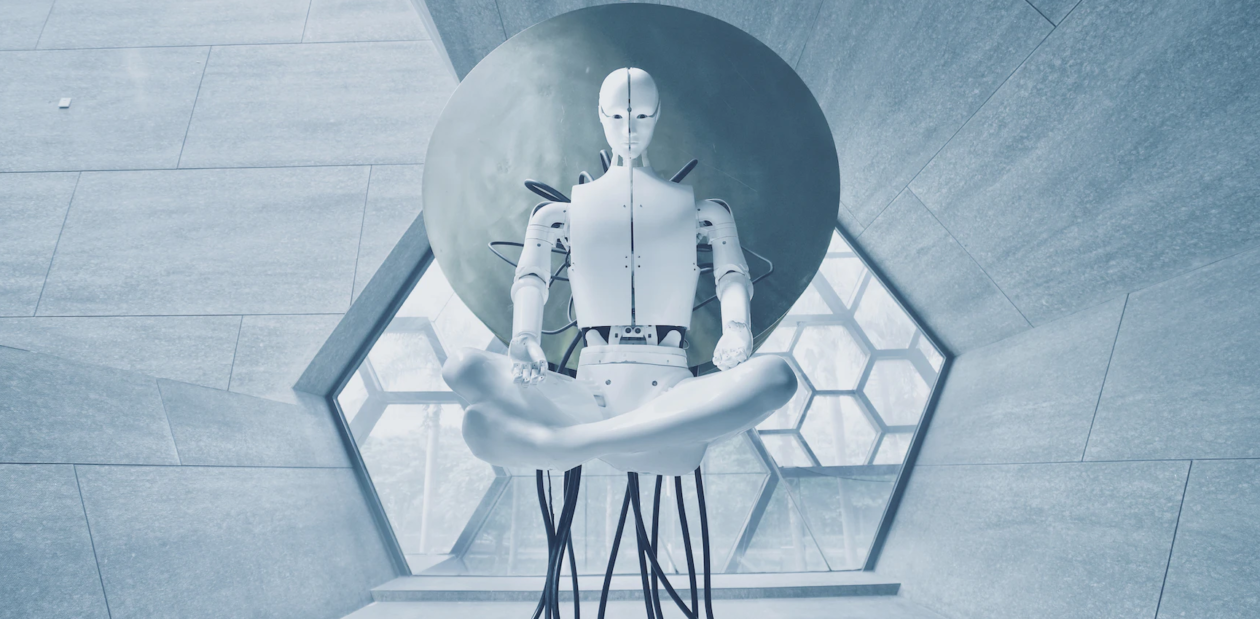
In our previous class, we discussed the question of whether AI is sentient, and we all mainly agreed that it is not. We see AI as nothing more than a tool that enhances human productivity and assists us to our every need. We control AI, but the more we command from it, the more we rely on it, until the technology consumes us and takes over (in a metaphorical sense).
Just recently, I watched an extraordinary film called Companion. It follows a couple, Iris and Josh, as they spend a getaway with Josh’s friends at a mansion in the woods. The catch? Iris is a robot. While the film is an absolutely mind-blowing allegory for misogyny and the emotional abuse of women from unstable and often evil men, using robots as a metaphor for people (can be anyone – there is a male robot in the film as well) who are stuck in controlled relationships was a rather interesting choice. Throughout the film, I picked up on the more subtle themes of how humans control AI, and what happens when they allow them to be self-aware.
Iris and [SPOILER] are both “companion bots” who end up both being literally manipulated by Josh. Iris spends the film figuring out her identity and autonomy after discovering who – or what – she really is. While the robot analogy really shines some light of accuracy in the film’s pro-feminist message, is it a good representation of AI and its “sentience?” What happens if we do let AI do everything for us? Will they become sentient in a way and take over the world like a lot of movies suggest? One can view Companion as a cautionary tale for the overuse of AI (although this conflicts with the pro-feminist message that makes us root for Iris). Either way, humans are the problem.
Going back to intention and writing, if we let AI write for us, we won’t need to think. We must know how to regulate our education of writing and the balance of the craft in the world of AI. Failure to do so may result in a global reliance of the machine. AI may not be sentient, but with enough reliance on it, AI will think for us. It will do for us. And that’s what would make AI sentient.
If you have time (and are okay with gory slashers), please check out Companion on Prime Video. The film stars Sophie Thatcher (she’s kind of my celeb crush- wait who said that) and Jack Quaid.
PS – I didn’t realize this until I saw a Letterboxd review for the film – ‘Iris’ is an anagram for ‘Siri.’ That’s insanely genius.


