In Chapter 5 of Burnout from Humans, the AI model discusses the term “co-stewardship. While the model does discuss this, in paired reading, titled “Empowering Learners for the Age of AI,” the many authors discuss that young adults struggle with identifying the validity of AI models, and whether or not their information is accurate.
At this point, we have found ourselves at a crossroad. The question we are being asked is not whether or not we should continue improving AI, but whether or not we should be teaching students how to use it in schools. This is, ofcourse, a double-edged sword. One could argue that we would be teaching students how to cheat on exams, tests, assignments, etc. While another person might argue that this would allow students to seek clarification during after-school hours when their teacher normally wouldn’t be able to provide immediate feedback.
In the article, there are four domains: Engaging with AI, Creating with AI, Managing AI, and Designing AI. At this point, yes, AI does have to be properly managed and accurately designed. However, 49% of 17-27 year olds struggle with two domains: Engaging with AI, and Creating with AI. I find it interesting, because 49% of students between the ages of 12-17 believe that AI being implemented into schools will only widen existing academic gaps between peers. I think that this suggests that the implementation will not be consistent among different classrooms. I will say that there would be major pushback to implementing AI into classrooms.
I am interesting in this topic, and I look forward to discussing our thoughts on Wednesday.
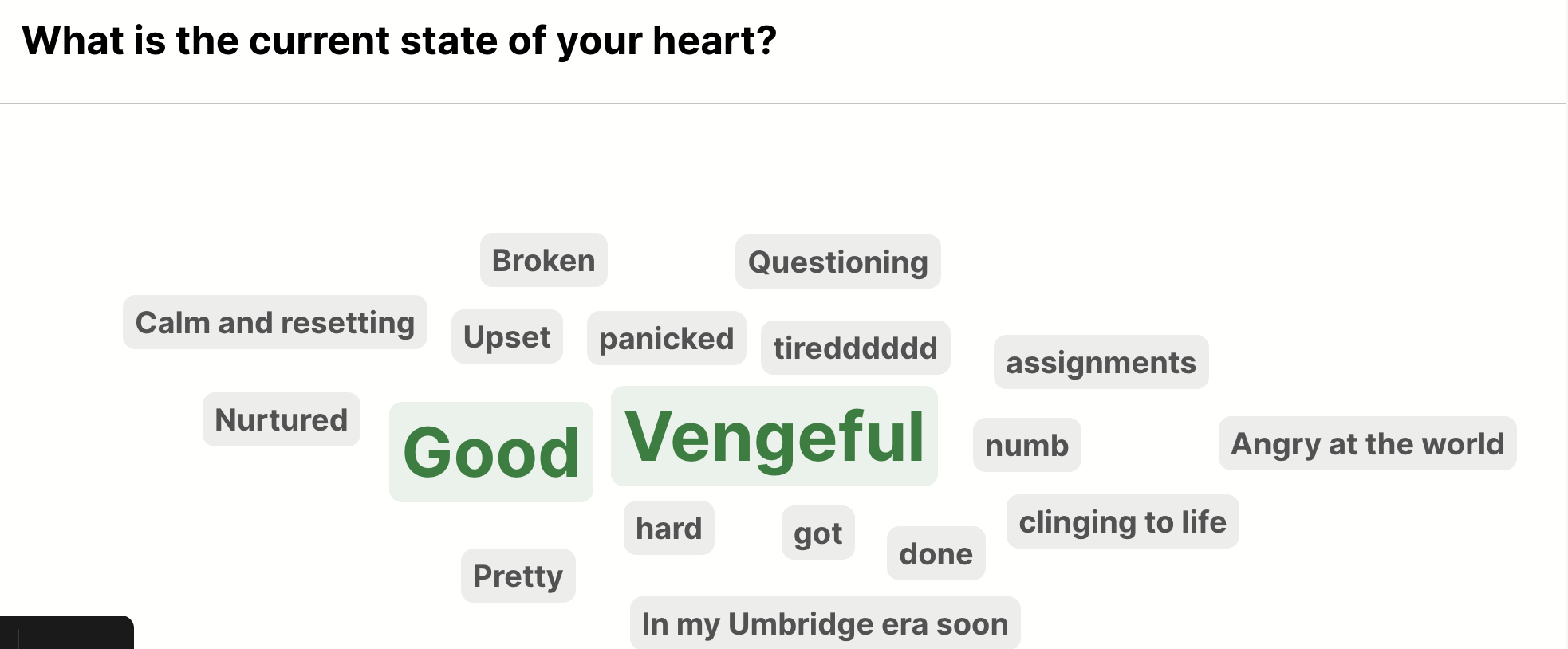
The start of class this week left an impact. You admitted a lot of truly difficult feelings in our anonymous word cloud survey, and even though this unsettles my heart, I truly appreciate your candor and the truth of the human place you find yourselves in.
We know there is no machine or algorithm that can account for our human history, our personal human encounters – all our accrued feelings and the meaning we must sort behind those experiences. I do think we need to get better at apprehending how we truly are, before we can ever venture to learn (either as individuals, and even more so, in community with others). I am glad we took a bit of time to write a bit about the experience of burnout, and to consider what it means to locate burnout in relational networks rather than just inside one’s own fraught heart. I know it is important to connect what we experience individually to a broader systemic lens. It follows that this notion of “self-care”, as a purely individual journey alone, is not working. Self-care cannot be solely an individual endeavor because well-being is shaped by social, institutional, and structural conditions, not just personal habits. And so we spoke together about the idea of “composting harm”.
If burnout is relational and harm must be composted, what new practice might you experiment with this semester? This is about transforming injury rather than denying, bypassing, or simply “moving on” from it. Like organic waste, the harm we experience must be worked through, turned, aired, and metabolized within a community. Composting harm means staying with discomfort, acknowledging complicity, and engaging in relational repair so that what was damaging can become the ground for new forms of accountability, solidarity, and practice. I think that this concept resists the idea that individuals can privately “self-care” their way out of structural harm. Instead, it frames healing and change as ongoing, relational processes that can transform residue into nourishment. But of course, it is troubling that it is Aidan Cinnamon Tea is “the voice” that is urging us to think of it. Can we begin to imagine more just and sustainable ways of being together? Can we embed humanistic values of care into the widespread tools we use to navigate the world moving forward?
What about music?
Thanks to Veronica & Jacob who had us all read “Nick Cave Says ChatGPT’s AI Attempt to Write Nick Cave Lyrics “Sucks.” We started with a simple question. What is music? Together, we thought about this concept of music, and then we considered the role that suffering and loss plays in the process of making meaningful art. And we played a game, attempting to identify what music was machine made, and what music was human made. We agreed that some human made music can be as vacuous as the AI songs that are built from previous sounds arrangements and patterns. What seemed to be at stake in our short game was our ability to “detect the soul” of artistic expression. To our dismay, the game was not so easy to play. So what does this tell us?
We all seem to harbor hope that art isn’t just a set of stylistic patterns that can be statistically reproduced. Rather, it carries subjectivity, lived experience, intention, emotional depth, and meaning in context. Nick Cave’s dismissal of the AI lyrics speaks to the idea that what makes art genuine has to do with human consciousness. That means that our choices, vulnerabilities, our singular perspective hold something sacred to us. And computational approximation is an affront. And it seems clear that we don’t want to play this game of guessing all the time, as we keep trying to live our lives. What choices will we have moving forward?
For next week:
Michael will be our next pathfinder and he will lead a discussion of teaching, learning, and education in the Age of AI. To prep for this conversation, please read: