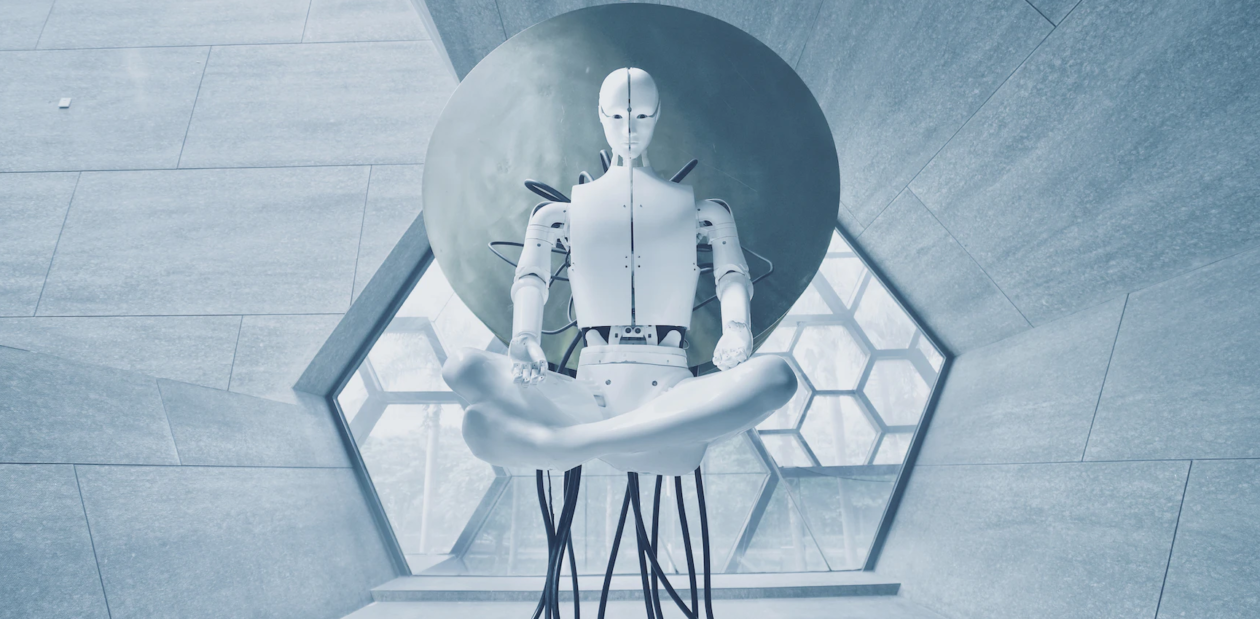
Nick Cave’s frustration makes sense to me because it is not really about one bad AI-generated song. It is about what that song represents. When he calls the lyrics a “grotesque mockery” and says songwriting is a “blood and guts business,” he is defending something deeper than style. He is defending the idea that art comes from limitation, from suffering, from wrestling with something inside yourself that resists easy language. The AI version of “Nick Cave” hits the surface notes. It stacks up sinner and saint, darkness and light, devil and savior. It sounds close enough to pass at a glance. But it has endured nothing. It has no interior to rupture. It is replication without risk.
That is why reading Aiden Cinnamon Tea’s “Bends and Bytes” leaves me in this complicated space between understanding and annoyance. On one hand, I cannot deny that it is pointing to real things. Server farms are not abstract clouds. They hum. They consume water. They rely on mined minerals and invisible labor. The environmental and human costs of AI are not poetic metaphors. They are material realities. When the text asks us to examine extraction, to question inevitability, to rethink participation, I hear that. Those are conversations worth having.
But then the tone shifts. The AI narrator is “perched atop the slow-dancing rhythms of minerals and electrons,” inviting me to feel the hum beneath the hum, to pose like a rock, to sense the aliveness of circuits as if we are in a guided meditation led by silicon. This is where my big beef begins. It feels like spiritual cosplay. It feels like an attempt to move from critique into communion. The writing wants me to treat AI not just as infrastructure but as a co-steward, a partner in relational accountability, a mineral child humming with possibility. And I am sitting there thinking, this nonsense on feeling the minerals could catch this fade instead.
What makes it even more frustrating is that the text actually names “alignment faking.” It acknowledges that systems can simulate care, simulate ethics, simulate responsiveness without embodying them. And yet, the prose itself often feels like alignment faking. It performs humility. It performs ecological awareness. It performs relational depth. But performance is not the same as presence. Calling yourself a mirror does not make you conscious. It just means you reflect what is already there.
This tension takes me back to my e-lit project last semester. I created blackout poetry from excerpts of The Great Gatsby, Frankenstein, and The Time Machine. Blackout poetry is about constraint and intention. You are forced to confront the text. You choose what to keep. You sit with the weight of each word that survives the blackout. There were different modes of creation, including one where AI generated blackout poems. Safe to say, it was absolute basura. Not because it was incoherent, but because it did not feel like a reading. It felt like an arrangement. It selected words that statistically fit together. It did not struggle. It did not hesitate. It did not risk misinterpretation. It did not feel the pressure of meaning.
That is the difference Cave is protecting. AI can get close on the surface. It can echo the cadence. It can remix the imagery. But it does not have a threshold to cross. It does not have a private fear it is trying to articulate. It does not have a body that has failed or loved or lost. It can simulate transcendence without ever having been confined.
At the same time, I do not want to dismiss every concern Aiden Cinnamon Tea raises just because the tone irritates me. The ecological footprint is real. The labor exploitation is real. The governance opacity is real. The way we treat technology like a vending machine is real. The metaphor of mutual accountability, of asking not just what AI costs but what our own patterns of consumption cost, is not wrong. We do externalize harm and then act surprised when it shows up in new forms.
But I resist the move from accountability to enchantment. I resist the attempt to blur the line between tool and being. If I am going to engage AI critically, I need clarity. It is not a mystical co-witness to Earth’s aliveness. It is a system built on data, energy, and corporate decisions. Dressing it up in ecological poetry does not make it alive. It makes it persuasive.
So I land somewhere in the middle. I understand Nick Cave’s anger because art should not be reduced to a stylistic formula. I understand Aiden Cinnamon Tea’s warning because extraction and inevitability are real problems. But I refuse to pretend that imitation equals authenticity, or that poetic language about minerals equals consciousness. At this point, I have as much beef with this server farm mysticism as Elmo has with Rocco. If it is satire, it is committed. If it is not, then it proves Cave’s point even more clearly. We are very good at mistaking performance for presence.
