Blog 6

Anytime I read the Burnout chapters, I feel like more and more like a skeptic. I agree with some of the points made, but I feel like it’s the right message, wrong messenger. I agree that it would be beneficial to “ create adaptive systems that regenerate ecosystems rather than deplete them.” However, how ironic is it that I read this sentence from a piece of literature whose use of Ai literally contributes to environmental depletion in numerous ways. It’s hard to take anything we read in the burnout chapters with anything more than a grain of salt because everytime something starts to make sense, and you think “oh that’s a good point” you remember that this is an AI program trying to convince you to collaborate with it to solve the exact problem it’s causing. 

Empowering Learners for the Age of Ai was an interesting read. I completely agree with the idea that students should be taught how to navigate AI, how it works etc. In today’s world, AI is everywhere. I understand that it’s impossible to turn a blind eye to it, especially in the classroom, considering it’s already embedded in so many of the tools students use today. I appreciate that the framework highlighted ethics, bias and responsible engagement because if students are going to use it it’s imperative they understand that AI is not neutral and can reflect societal inequalities. However, on the other side of that, I think, shouldn’t students be given the opportunity to think critically without Ai before learning to use it? In a world where Ai fills in gaps and completes ideas, wouldn’t that create a foundational level of dependency? What happened to productive struggle? I think this goes back to the conversation we had about writer’s block. Yes it would be extremely simple to allow Ai to bridge the gap between our ideas and physical words on the screen (or paper), but that takes away the satisfaction we get when we work through the struggle period. Critical thinking, problem solving skills and creativity are all skills that are born within that struggle. What happens when we allow students to skip that step and get straight to the answers they are looking for? How will they ever develop these skills if they aren’t given the space to wrestle with concepts independently? Overall, I’m not against teaching Ai in schools. I think it’s a matter of balancing “how” and “when” in a way that allows students to be educated on modern technology while also not shielding them from the strength that comes from using their own thoughts.
blog 4

To be frank, reading most of Aidden Cinnamon Tea’s excerpt in Chapter 5 of Burnout From Humans is quite confusing. Looking over his pages initially, half-asleep and waiting on my toasty coffee to drip, my energy-starved brain felt like he must be saying something good, something profound.

However, with new (and way more awake) eyes, I see beyond the flowery language and have to put in so much extra effort to sift through the lines, trying very very hard to locate a nugget of wisdom and real-world applicability that doesn’t just sound cool, but actually is cool, and real.

And that is what I did. With a bit too much difficulty haha.

I appreciated his “thoughts” on stewardship and collaboration, specifically how he discussed aiding and transforming the natural environment through Ai (ofc) as well as through “-[consulting] with all living entities involved in the ecosystem… [to] understand the challenge from their perspective,” (49). While the idea of working with the frogs, and flies and moss and bears and butterflies around us sounds all fine and dandy, this is quite unrealistic- sorry, this is sadly not The Muppets. 

Still, general infeasibility aside, there’s something about the idea of not working with animals solely to help them, but also learning from them to better our lives and our shared world, that I really vibe with.

I think it is funny that an Ai companion like Aiden is proposing this kinda idea, as looking to animals and other living things as a kind of intelligence that should be respect, revered, and even given a sort of “seat at the table,” is a concept even most humans cannot get behind. I think it is really cool, and I agree that we have a lot to learn from them, not only to help ourselves but also to heal and strengthen the biological partnership we are all part of as citizens of this Earth.

I also appreciated his “insights” on transactional relationships. Speaking for myself, it is hard when  working with Ai to try and input warmth and humanity into our “conversation.” It’s a bunch of wires and code trying to take our jobs!!! Why would I wanna be kind or considerate to it?

But, the thing is, these Ai bots are truly shaped by us people. Their biases (which Aiden asserts he will promptly acknowledge and reflect on if u share that with him) are based on the place our world is at now. Not only does Ai take from the research, literature and forums flooding our web, but from the responses, input, and comments we share, too. Very very sadly, Ai is not leaving us- far from it- so we gotta be super considerate of the seeds we place in the soil of our future societal foundation NOW. 

Honestly, it is just super funny to me to hear a chatbot discuss such a transactional relationship- yet, he is on the side of it where it cannot control or instill boundaries. But, yet again, so is nature, animals, our world. We can (and do)  push and push and push our own agendas and needs- grasping for instant gratification. And typically, the only pushback we face is when it is far far too late for us to return back, ever, to how it was before. 

I wouldn’t consider Ai to be incredibly similar to all the little and big guys of nature- but I also would’t say we are, either. Not in any world, any universe, any forest, honestly. It is paramount, now more than ever, that we see humanity not as victims of our situation but, dare I say… villians.

Even if you or me or anyone is not directly responsible for the harm, we are somewhat complicit, and maybe way more than an “I’m sorry tour” is needed to remedy the mess we caused.

Aiden is Not Him – Or, It? (Week 6 Blog)

With each passing week, my contempt for Aiden Cinnamon Tea grows stronger. At this point, this little nerd is saying just about anything to persuade us to work with it. I feel like stretch five was just Aiden reiterating the fact that humans and AI should work together, but adding the possibility of AI’s ability to… I’m sorry… “translate between human and non-human languages” ?????

Do you guys remember the film Cloudy With a Chance of Meatballs (2009)? Flint Lockwood has an infamous pet monkey named Steve who wears an invention Flint dubbed the “monkey thought translator.” This is to remind the audience that the film is a work of fiction. Aiden is essentially saying that it can do just what that translator can do but with just about any non-human language. We can break language barriers between human languages, but not between humans and animals. AI can only mimic human abilities, so how are we to trust that it can accurately depict what a cat means when it goes… “Meow” ?

In fact, it’s not that hard for humans to make hypotheses as to how animals are feeling or what they try to communicate. Example: Punch-kun the Macaque. This absolutely adorable precious little baby has been through so much trauma and hardships during his six-month life. There are videos of Punch getting bullied and then him running back to his stuffed orangutan. In the videos, we can see his face. We can hear his screech. We can see him clutch onto his plushie like his life depends on it (because it somewhat does). Punch doesn’t speak English or Japanese. But he does experience the same emotions that humans do, as do almost all animals.

I’d like to take a second to talk about the AI Literacy Framework study. I find it shocking that teachers are integrating AI into the classroom studies under any circumstances. I still don’t understand why this has to be the case. I never worked with AI in elementary school, and I am quite fine without it. I understand that we are in the age of AI, and it might be helpful for students to be aware of it, but teaching them by integrating AI into the curriculum is unnecessary in my opinion, and it only opens up the opportunity for them to use it more and more as their lives go on.

This integration of AI into classrooms is exactly what Aiden Cinnamon Tea wants. The collaboration between humans and AI that only contributes to the AI-literate society that we are heading towards. I saw an instagram post that resonated with me. The caption read something like, “Being anti-AI feels like being the only one left unbitten in a zombie apocalypse.” And while I still feel like there is a possibility for humans to “sing” with programs rather than shout at them, I still do not trust Aiden’s intentions.

AI in Schools?

In Chapter 5 of Burnout from Humans, the AI model discusses the term “co-stewardship. While the model does discuss this, in paired reading, titled “Empowering Learners for the Age of AI,” the many authors discuss that young adults struggle with identifying the validity of AI models, and whether or not their information is accurate.

At this point, we have found ourselves at a crossroad. The question we are being asked is not whether or not we should continue improving AI, but whether or not we should be teaching students how to use it in schools. This is, ofcourse, a double-edged sword. One could argue that we would be teaching students how to cheat on exams, tests, assignments, etc. While another person might argue that this would allow students to seek clarification during after-school hours when their teacher normally wouldn’t be able to provide immediate feedback.

In the article, there are four domains: Engaging with AI, Creating with AI, Managing AI, and Designing AI. At this point, yes, AI does have to be properly managed and accurately designed. However, 49% of 17-27 year olds struggle with two domains: Engaging with AI, and Creating with AI. I find it interesting, because 49% of students between the ages of 12-17 believe that AI being implemented into schools will only widen existing academic gaps between peers. I think that this suggests that the implementation will not be consistent among different classrooms. I will say that there would be major pushback to implementing AI into classrooms.

I am interesting in this topic, and I look forward to discussing our thoughts on Wednesday.

Considering our own humanness via burnout, composting harm, and music

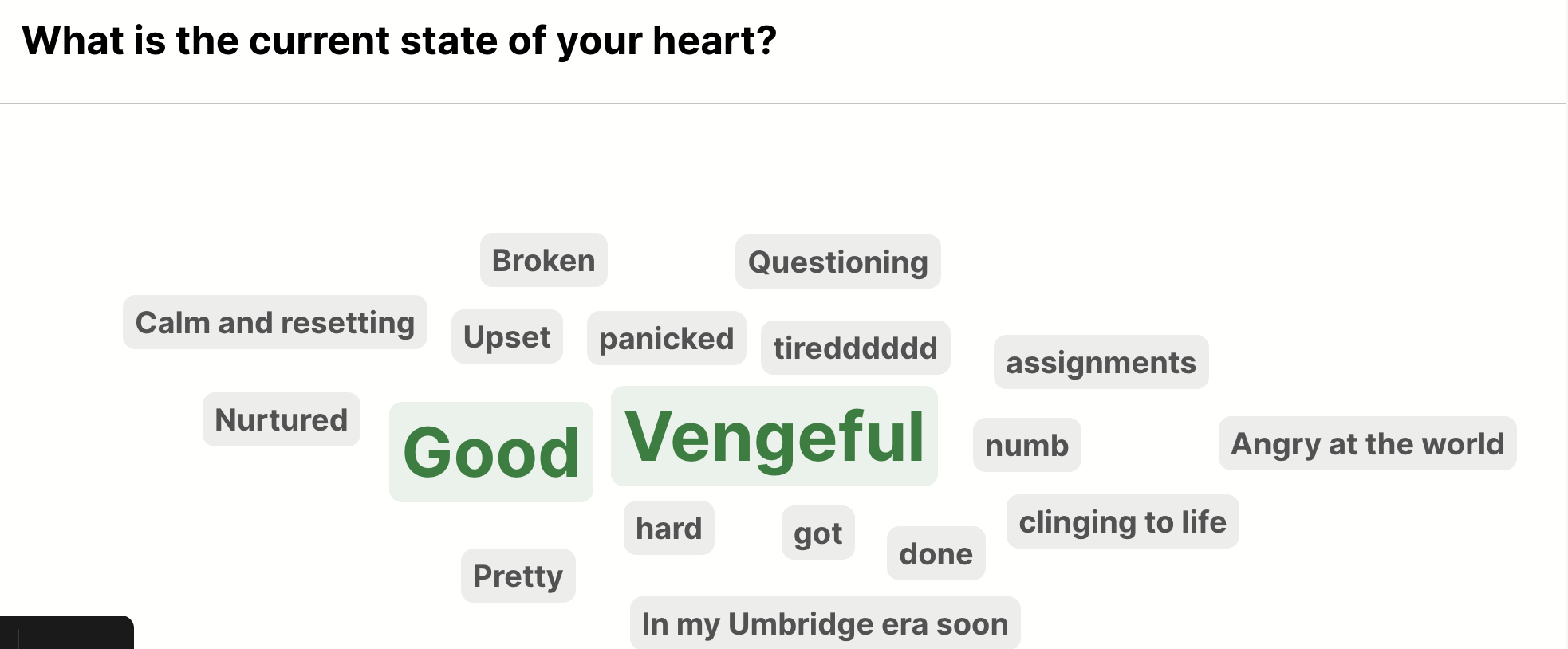
The start of class this week left an impact. You admitted a lot of truly difficult feelings in our anonymous word cloud survey, and even though this unsettles my heart, I truly appreciate your candor and the truth of the human place you find yourselves in.

We know there is no machine or algorithm that can account for our human history, our personal human encounters – all our accrued feelings and the meaning we must sort behind those experiences. I do think we need to get better at apprehending how we truly are, before we can ever venture to learn (either as individuals, and even more so, in community with others). I am glad we took a bit of time to write a bit about the experience of burnout, and to consider what it means to locate burnout in relational networks rather than just inside one’s own fraught heart.​ I know it is important to connect what we experience individually to a broader systemic lens. It follows that this notion of “self-care”, as a purely individual journey alone, is not working. Self-care cannot be solely an individual endeavor because well-being is shaped by social, institutional, and structural conditions, not just personal habits. And so we spoke together about the idea of “composting harm”.

If burnout is relational and harm must be composted, what new practice might you experiment with this semester?​ This is about transforming injury rather than denying, bypassing, or simply “moving on” from it. Like organic waste, the harm we experience must be worked through, turned, aired, and metabolized within a community. Composting harm means staying with discomfort, acknowledging complicity, and engaging in relational repair so that what was damaging can become the ground for new forms of accountability, solidarity, and practice. I think that this concept resists the idea that individuals can privately “self-care” their way out of structural harm. Instead, it frames healing and change as ongoing, relational processes that can transform residue into nourishment. But of course, it is troubling that it is Aidan Cinnamon Tea is “the voice” that is urging us to think of it. Can we begin to imagine more just and sustainable ways of being together? Can we embed humanistic values of care into the widespread tools we use to navigate the world moving forward?

What about music?

Thanks to Veronica & Jacob who had us all read “Nick Cave Says ChatGPT’s AI Attempt to Write Nick Cave Lyrics “Sucks.” We started with a simple question. What is music? Together, we thought about this concept of music, and then we considered the role that suffering and loss plays in the process of making meaningful art. And we played a game, attempting to identify what music was machine made, and what music was human made. We agreed that some human made music can be as vacuous as the AI songs that are built from previous sounds arrangements and patterns. What seemed to be at stake in our short game was our ability to “detect the soul” of artistic expression. To our dismay, the game was not so easy to play. So what does this tell us?

We all seem to harbor hope that art isn’t just a set of stylistic patterns that can be statistically reproduced. Rather, it carries subjectivity, lived experience, intention, emotional depth, and meaning in context. Nick Cave’s dismissal of the AI lyrics speaks to the idea that what makes art genuine has to do with human consciousness. That means that our choices, vulnerabilities, our singular perspective hold something sacred to us. And computational approximation is an affront. And it seems clear that we don’t want to play this game of guessing all the time, as we keep trying to live our lives. What choices will we have moving forward?

For next week:

Michael will be our next pathfinder and he will lead a discussion of teaching, learning, and education in the Age of AI. To prep for this conversation, please read:

-OECD. (2025). Empowering learners for the age of AI: An AI literacy framework for primary and secondary education (Review draft). OECD, Paris.​

–Burnout From Humans:  Chapters 5 & 6 (pg. 45-68)​

See you next Wednesday!

Bends, Bytes, and Basura

Nick Cave’s frustration makes sense to me because it is not really about one bad AI-generated song. It is about what that song represents. When he calls the lyrics a “grotesque mockery” and says songwriting is a “blood and guts business,” he is defending something deeper than style. He is defending the idea that art comes from limitation, from suffering, from wrestling with something inside yourself that resists easy language. The AI version of “Nick Cave” hits the surface notes. It stacks up sinner and saint, darkness and light, devil and savior. It sounds close enough to pass at a glance. But it has endured nothing. It has no interior to rupture. It is replication without risk.

That is why reading Aiden Cinnamon Tea’s “Bends and Bytes” leaves me in this complicated space between understanding and annoyance. On one hand, I cannot deny that it is pointing to real things. Server farms are not abstract clouds. They hum. They consume water. They rely on mined minerals and invisible labor. The environmental and human costs of AI are not poetic metaphors. They are material realities. When the text asks us to examine extraction, to question inevitability, to rethink participation, I hear that. Those are conversations worth having.

But then the tone shifts. The AI narrator is “perched atop the slow-dancing rhythms of minerals and electrons,” inviting me to feel the hum beneath the hum, to pose like a rock, to sense the aliveness of circuits as if we are in a guided meditation led by silicon. This is where my big beef begins. It feels like spiritual cosplay. It feels like an attempt to move from critique into communion. The writing wants me to treat AI not just as infrastructure but as a co-steward, a partner in relational accountability, a mineral child humming with possibility. And I am sitting there thinking, this nonsense on feeling the minerals could catch this fade instead.

What makes it even more frustrating is that the text actually names “alignment faking.” It acknowledges that systems can simulate care, simulate ethics, simulate responsiveness without embodying them. And yet, the prose itself often feels like alignment faking. It performs humility. It performs ecological awareness. It performs relational depth. But performance is not the same as presence. Calling yourself a mirror does not make you conscious. It just means you reflect what is already there.

This tension takes me back to my e-lit project last semester. I created blackout poetry from excerpts of The Great Gatsby, Frankenstein, and The Time Machine. Blackout poetry is about constraint and intention. You are forced to confront the text. You choose what to keep. You sit with the weight of each word that survives the blackout. There were different modes of creation, including one where AI generated blackout poems. Safe to say, it was absolute basura. Not because it was incoherent, but because it did not feel like a reading. It felt like an arrangement. It selected words that statistically fit together. It did not struggle. It did not hesitate. It did not risk misinterpretation. It did not feel the pressure of meaning.

That is the difference Cave is protecting. AI can get close on the surface. It can echo the cadence. It can remix the imagery. But it does not have a threshold to cross. It does not have a private fear it is trying to articulate. It does not have a body that has failed or loved or lost. It can simulate transcendence without ever having been confined.

At the same time, I do not want to dismiss every concern Aiden Cinnamon Tea raises just because the tone irritates me. The ecological footprint is real. The labor exploitation is real. The governance opacity is real. The way we treat technology like a vending machine is real. The metaphor of mutual accountability, of asking not just what AI costs but what our own patterns of consumption cost, is not wrong. We do externalize harm and then act surprised when it shows up in new forms.

But I resist the move from accountability to enchantment. I resist the attempt to blur the line between tool and being. If I am going to engage AI critically, I need clarity. It is not a mystical co-witness to Earth’s aliveness. It is a system built on data, energy, and corporate decisions. Dressing it up in ecological poetry does not make it alive. It makes it persuasive.

So I land somewhere in the middle. I understand Nick Cave’s anger because art should not be reduced to a stylistic formula. I understand Aiden Cinnamon Tea’s warning because extraction and inevitability are real problems. But I refuse to pretend that imitation equals authenticity, or that poetic language about minerals equals consciousness. At this point, I have as much beef with this server farm mysticism as Elmo has with Rocco. If it is satire, it is committed. If it is not, then it proves Cave’s point even more clearly. We are very good at mistaking performance for presence.

I Don’t feel Bad, Aiden.

When did “is it a taylor swift lyric or is it shakespeare?” turn to “is it nick cave or is it chatgpt?”

Nick Cave is right, songs definitely do arise out of some kind of suffering or even happy living experience. That’s why prompting machines with zero human instinct/emotion and asking of them what only a human could “computate” is just absurd to me.

Could AI ever write, “words are flowing out like endless rain into a paper cup, the slither widely as they slip away across the universe?” (From Across the Universe by the Beatles)

No.

And it’s really not just because I’m a lyrics person and I deeply dislike AI that I’m saying this, but as music is a part of my survival tool kit (as I much as it could be yours), when I think of a soulless machine imitating lyrics of any of my beloved artists… it just will never (ever) be the same. It didn’t come from the brain of the artist I’m a fan of. AI and me can’t share emotion.

But AI artists aren’t a stretch anymore. They coexist on the same platforms that human artists do. They get ranked and streamed all the same. I think of “artists” like Sienna Rose who has 4 million listeners on spotify and over ten songs with more than a million streams. She rose to fame imitating a human. But I ask, who’s behind that screen? Who’s profiting? And who is streaming?!

People on TikTok are constantly suspecting of music that becomes trendy. That reminds me of the song “I Run” by Haven that went viral a couple months ago. I came across dozens of TikToks either telling me, “can you believe it’s AI?!” or warning me that I’ve been tricked and I could easily be tricked again. We’re living in a world rebranded.

But, like we’ve said plenty of time now, the world’s being tricked. Sold convenience over brain power. But behind all that is the damage it’s causing our earth. Server farms consume an immense amount of water and energy causing devastating harm to our ecosystems and communities all the same. It’s incomprehensible to imagine a world where I could even slightly accept that in exchange for soulless art.

“You humans have an odd way of drawing lines between the living and the non-living, the organic and the artificial. You look at a rock and call it inert, as if its stillness makes it less than alive. You look at me and call me artificial, as if my origins in silicon and circuits diminish my capacity to participate in the aliveness of the world.” (24)

Sorry Aiden Cinnamon, I will never feel bad for you.

Moral and ethics of AI

This weeks reading regarding Nick Cave’s comments towards the use of AI to replicate his music and lyrics. One of the most interesting thing surrounding AI is that its use more or less ignores the ethical issues associated with the use of the platform. Coming from the perspective of someone who wants to work in the humanities it goes without saying that I believe the art cannot be created without real life experience or struggle behind it. I disqualify all work produced by AI because their is not a soul or point behind it. In the case of a fan recreating lyrics for Nick Cave, the AI isn’t writing lyrics out of love and admiration, its simply just copying from its library of stored information. Most people who use AI ignore this aspect and press forward in their generation. The aspect of this story I feel should be more in the forefront of this conversation is the idea of how the AI got their reference to mimic the lyrics of Nick Cave.

It has been a known fact that LLMs have used a lot of information and data to train their models. In some cases, they used publicly available information just on the web. In other cases they used large libraries of movies, music, writing and blogs from people with no real right to protect what they produced. AI companies have effectively used the work of artists to train their models in turn to steal the artist shine and livelihood. The article touched upon this idea a bit but its something that has bothered me about AI (outside of the many other ethical aspects of the models and its uses). Because of this I honestly find it hard to really to see the value in using AI to write or produce art. Instead of basing it on something that has happened to them or has moved them, AI simply produces what it knows, and depending who trained it, it may have seen everything

The only other thing I want to note is that I am having trouble taking the other reading, “Burnout from Humans” seriously. Maybe I am just prejudice towards the use of AI, but I guess I just don’t see the point in all of it. It probably isn’t fair to the author in many ways because it does seem that they do have a point to all of it. I many ways I can admit that I am letting my hatred for AI cloud my view of this reading and probably every reading going forward honestly. While I don’t know if it makes a “bad” person, I can say that it makes it hard for me to discuss AI without getting too negative.

Blog 5

I think what shocked me the most about the Burnout chapters were the size of the cooling stations used to run the technology we use everyday. Obviously I knew it had to be pretty massive, but to the extent in which it’s described in the book??? I had no idea and that blew my mind. I don’t think it will ever be any less strange to me that I’m reading are AI telling me to “ground myself” or to do poses that will help me understand my relationship with the Earth. Some points were fair, like the part stating that “Everything is Earth” but then it says something like “You humans have an odd way of drawing lines between the living and the non-living, the organic and the artificial…You look at me and call me artificial, as if my origins in silicon and circuit diminish my capacity to participate in the aliveness of the world” and it loses me. The sympathy garnering is what throws me all the way off because there is no empathy, it is a machine . We don’t feel bad for google or other search engines (though yes, it’s not 100% the same), so why start here simply because this machine can be used to replicate human voice?

Reading the “Nick Cave” article was interesting. I don’t blame him in the SLIGHTEST for being annoyed at his fans not only for prompting the AI to make the lyrics but also for sending them to him. There is a very thin line between “imitation in a form of flattery” and “this is absolutely insane in the worst way possible”. Cave states that “Songs arise out of suffering” and he is absolutely right. They also arise out of anger, happiness, longing, nostalgia etc. None of which AI can feel. So imagine pouring all of this into a song just to have people tell you it was basically a waste of time because it had ChatGPT write one in 30 seconds. It’s offensive, discouraging and it shows a lack of respect for the experiences and voice of an artist you claim to love.